
Travelers planning a trip to Thailand tend to ask the same question: how many days do I need? It is the right question asked at the wrong level of detail.
A 14-day trip in which 5 days are spent in Bangkok and 2 days in each of the four other destinations is not a 14-day trip. It is a 5-day Bangkok trip with four rushed additions. The total day count looks fine. The distribution collapses under examination.
There is also a cost that most itineraries leave out entirely. Every city change in Thailand takes at least half a day (hotel checkout, transport to the airport or station, the journey, arrival, check-in, orientation). A trip that crosses four regions in 14 days has spent at least 3 of those days in transit before a single activity is planned. What remains is 11 days across 4 destinations, averaging under 3 nights each.
Days in Thailand are not equal. A day that starts and ends in the same city is qualitatively different from a travel day. Most itineraries do not count the difference.
Quick Take
| Trip Length | Regions Possible | Recommended Structure | Transit Days Used | What Gets Compromised |
|---|---|---|---|---|
| 5–7 days | 1–2 | Bangkok only, or Bangkok plus Ayutthaya overnight | 0–1 | Nothing, if the scope matches the time |
| 8–10 days | 2 | Bangkok plus north OR Bangkok plus south | 1–2 | Depth at each stop is 3 regions attempted |
| 11–14 days | 2–3 | Bangkok plus north plus south | 2–3 | The southern leg is over-compressed |
| 15–21 days | 3–4 | Full north-to-south or both coasts | 3–4 | Nothing, if routing is linear |
| 21+ days | 4–5 | All regions, including Isaan or slow travel | 4–5 | Nothing |
Transit reference: Bangkok to Chiang Mai is a 1.25-hour flight or a 12-hour overnight train. Chiang Mai to Phuket requires a 1.5-hour flight; there is no direct train, and routing via Bangkok adds 3–4 hours. Bangkok to Koh Samui is a 1-hour flight or a 10–12-hour bus-plus-ferry combination. Phuket to Koh Lanta is 1.5–2 hours by ferry. Bangkok to Ayutthaya is 1.5 hours by train. The working rule: every inter-regional move costs at least half a day. Two inter-regional moves cost one full day.
The Short Answer
Five to seven days are enough to properly visit one region. Seven to ten days covers Bangkok and one other region without compression. Fourteen days is the minimum for Bangkok, northern Thailand, and one southern coast, with enough nights at each stop to feel settled rather than rushed.
Every additional destination beyond that requires either adding days or accepting shallower stays. One transit day is spent for each inter-regional move. A 14-day trip crossing four regions loses roughly 3 days to transit, leaving 11 days spread across four destinations: under 3 nights each on average.
The number of destinations and the number of days are not independent variables. Adding a destination without adding days does not enrich the trip. It compresses every stop already in it.
Days Per Destination: The Operational Breakdown
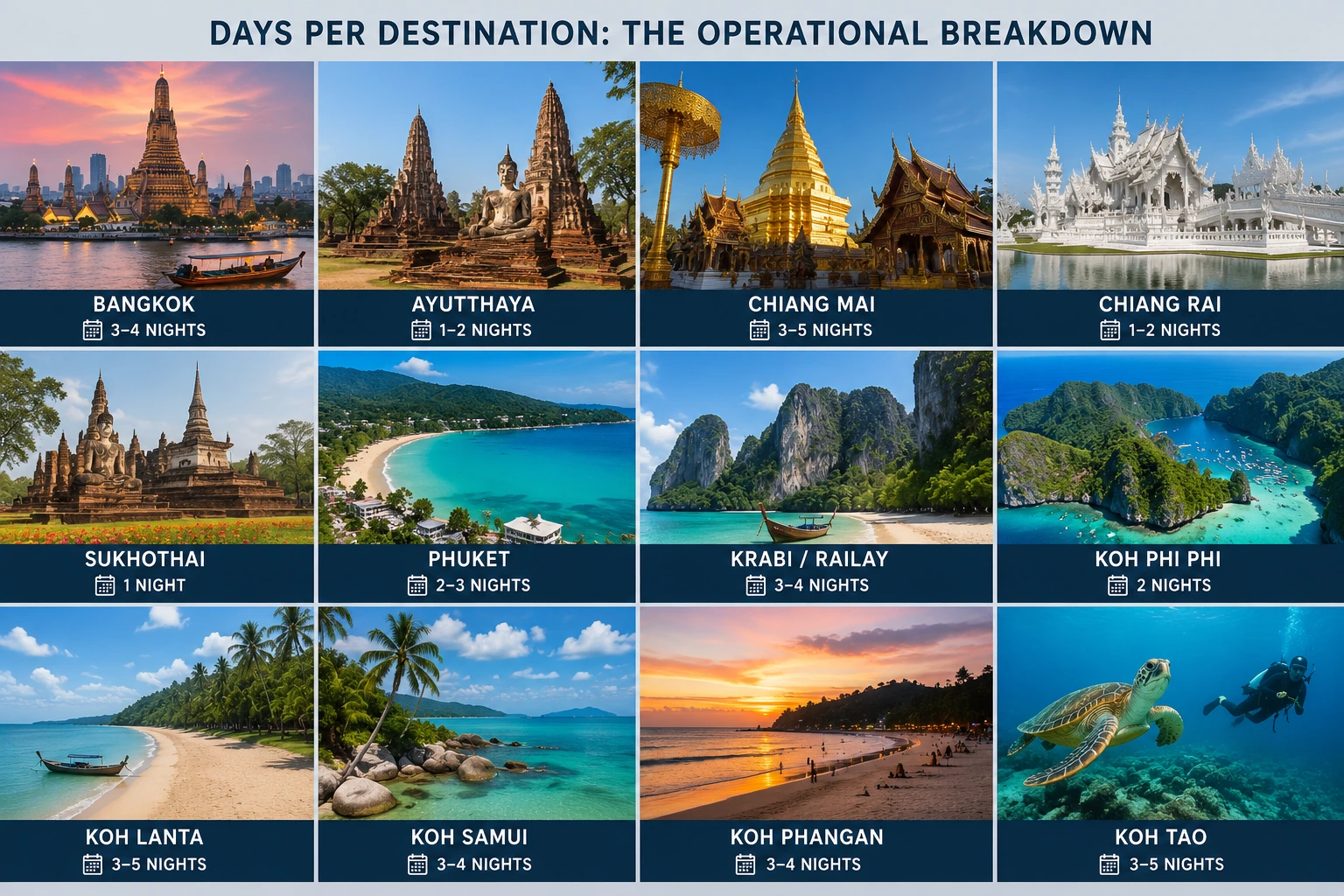
Bangkok: 3 nights minimum, 4 recommended
Bangkok is the destination most likely to receive too many days on a first trip and not enough on a return one.
Three nights provide two full days plus an arrival evening and a departure morning. It covers the temple circuit on day one (Grand Palace, Wat Pho, Wat Arun), a second full day for markets, neighborhoods, or a canal tour, and a half-day departure morning. Tight, but functional if the days are structured.
Four nights is the more comfortable allocation. It adds a third full day, which converts Bangkok from a processed checklist into a city with some depth. The difference between three and four nights here is the difference between covering the priorities and having one day that moves at the city's actual pace.
Two nights in Bangkok is a transit stop, not a city stay. Travelers who allocate two nights are functionally arriving, sleeping, and leaving. On a very short trip where Bangkok is genuinely a gateway rather than a destination, this is defensible. On a 14-day trip where two nights in Bangkok are reserved to make room for a fifth destination, it is not.
One practical constraint that affects the day count more than most travelers expect: Bangkok rewards early morning starts, particularly for temples and floating markets. A late-evening arrival on night one loses the first morning. Count usable days from the first full morning, not from the night of check-in.
Ayutthaya: 1 night minimum, 2 maximum
Ayutthaya does not need a long stay. It needs one full day: arrive by mid-morning, spend the full day on a bicycle or tuk-tuk through the historical park, and depart the next morning after an early start.
One night is the correct allocation for most travelers. Two nights suits travelers who want a very slow pace, a second full day for outlying temples, or a quiet break between Bangkok and the north.
Zero nights (a Bangkok day trip) is the most common structure, but it also produces the most rushed version of Ayutthaya. The problem is not the distance. Ayutthaya is 1.5 hours by train. It is the departure timing that a day-trip structure forces. Leaving Bangkok mid-morning to arrive at 11:00 AM loses the coolest part of the day. Leaving Ayutthaya by 4:00 PM to return to Bangkok eliminates the afternoon sites and the best evening light at Wat Chaiwatthanaram. One night in Ayutthaya costs approximately $30–100 and removes all of this friction.
Chiang Mai: 3 nights minimum, 4–5 recommended
Three nights in Chiang Mai cover the Old City temple circuit (one morning), Doi Suthep (one early morning), and the Saturday or Sunday Walking Street market. Tight, but functional if the days are structured in advance.
Four to five nights is where Chiang Mai becomes a trip rather than a stop. The fourth and fifth nights allow for half-day excursions outside the city (Chiang Rai, Doi Inthanon, an elephant sanctuary, a cooking class), and these excursions are where Chiang Mai moves from architectural interest to regional depth.
Two nights in Chiang Mai is the most consistent miscalculation in Thailand trip planning. It forces Doi Suthep to compete with the Old City circuit in a single day, typically resulting in one being skipped or both being done poorly. The city does not reward rushing.
One seasonal note worth confirming before booking: March through May in Chiang Mai is the burning season. Agricultural fires degrade air quality significantly across the north, and outdoor visits are qualitatively different during this window. November through February is the correct window for a culture-focused northern trip. The Thailand travel regions guide covers the full seasonal breakdown by region.
Chiang Rai: 1–2 nights
Chiang Rai is a single-day circuit of three sites (White Temple, Blue Temple, Baan Dam Museum) within driving distance of each other. One night allows for a morning arrival from Chiang Mai and a full day without rushing. Two nights suit travelers who want to add the Golden Triangle, Doi Tung, or the hill tribe villages north of the city.
The most efficient structure is Chiang Rai as an extension of a Chiang Mai stay rather than a standalone stop. Two nights at the end of a four or five-night Chiang Mai base is clean. Flying directly from Chiang Rai back to Bangkok avoids backtracking through Chiang Mai.
Southern Thailand (islands): 5 nights minimum, 7–9 recommended
The southern leg is where most Thailand itineraries run short.
Five nights allow for one island to be explored properly, or two islands at 2–3 nights each. Three nights on an island means two full days. Two nights means one full day. The difference between two and three nights on a Thai island is the difference between arriving briefly and settling into the pace of the place.
Seven to nine nights on the southern coast covers two to three islands without compression. This accounts for ferry transit days between islands (each costs half a day, identical to inter-regional moves on the mainland), arrival settling time, and one weather contingency day.
The coast choice must be made before allocating southern days. A traveler arriving November through April should be on the Andaman coast (Phuket, Krabi, Koh Phi Phi, Koh Lanta). A traveler arriving May through September should be on the Gulf coast (Koh Samui, Koh Phangan, Koh Tao). The two coasts do not connect by boat. Moving between them costs either a flight or a 5–6-hour overland transfer. A full day consumed by logistics.
The southern leg is also the section most vulnerable to fragmentation when a trip tries to fit in too much. Bangkok plus Chiang Mai plus three southern islands in 14 days requires 3 transit days, leaving 11 days across 5 destinations. Something fails. It is usually the islands.
Sukhothai: 1 night
Sukhothai requires a deliberate detour. Positioned between Bangkok and Chiang Mai but not on the standard flight corridor, it suits travelers on a culture-focused trip who want the full historical arc.
One night is all it needs. Arrive in the afternoon, visit the historical park the next morning by bicycle (4–5 hours in the central zone), then continue north by bus. The routing works as an overnight stop between Ayutthaya and Chiang Mai: Sukhothai (13th century) to Ayutthaya (14th to 18th century) to Chiang Mai's Lanna tradition (13th century onward) tells a more complete architectural story than skipping directly from Bangkok to Chiang Mai.
Which Time Frame Fits Your Trip
5–7 days: Bangkok only, or Bangkok plus one Ayutthaya overnight. Three to four nights in Bangkok and one night in Ayutthaya use the week correctly. Do not attempt Chiang Mai on this trip unless Bangkok is reduced to two nights and the trade-off is understood.
8–10 days: Bangkok (3 nights), plus Chiang Mai (3 nights), plus 2 transit days. Clean, reliable, no rushed stops. Alternatively: Bangkok (2 nights) plus southern coast (6–7 nights) on one coast only. Both work. Combining north and south at this length produces 2 nights everywhere, and the sense that nothing was seen properly.
11–14 days: The minimum for the full Bangkok-north-south structure. Bangkok (3 nights), Ayutthaya overnight (optional), Chiang Mai (3–4 nights), southern coast (5–6 nights), 3 transit days consumed. This is the trip most visitors mean when they say "Thailand in two weeks." The Thailand 2-week itinerary guide covers the full day-by-day structure, including domestic flight windows and the booking sequence.
15–21 days: Room for both Andaman and Gulf coasts with a flight between them, or the full northern circuit at a slower pace covering Bangkok, Ayutthaya, Sukhothai, Chiang Mai, and Chiang Rai without any stop being rushed.
21+ days: Isaan (northeast Thailand) becomes viable. Slow travel on a single island for 5–7 nights becomes practical. Second-tier northern destinations (Pai, Lampang, Mae Hong Son) open up. A 21-day Thailand trip is still discovering the country.
Minimum Nights by Destination
| Destination | Minimum Nights | Comfortable Stay | What the Minimum Misses |
|---|---|---|---|
| Bangkok | 3 | 4 | One unscheduled day, a floating market or a second neighborhood |
| Ayutthaya | 1 | 1–2 | Afternoon light at Wat Chaiwatthanaram on a day trip |
| Chiang Mai | 3 | 4–5 | Day trip outside the city (Chiang Rai, Doi Inthanon, cooking class) |
| Chiang Rai | 1 | 2 | Golden Triangle, Doi Tung, hill tribe villages |
| Sukhothai | 1 | 1 | Nothing; it is a one-day site |
| Phuket | 2 | 3 | Exploration beyond the resort corridor |
| Krabi / Railay | 3 | 4 | Slower days; second full snorkeling or climbing day |
| Koh Phi Phi | 2 | 2 | Nothing; two nights is the right stay for most travelers |
| Koh Lanta | 3 | 4–5 | The reason most people go: pace, not sights |
| Koh Samui | 3 | 3–4 | Day trip to Ang Thong Marine Park |
| Koh Phangan | 3 | 3–4 | East coast beaches; Full Moon Party (confirm date before booking) |
| Koh Tao | 3 | 4–5 | Dive certification; second dive or snorkel day |
What Most Guides Get Wrong
Counting nights instead of usable days.
A "3-night Bangkok stay" that includes a late-evening arrival and an early-morning departure is not 3 days. It is closer to 1.5. The arrival evening is consumed by check-in and dinner. The departure morning is consumed by packing and transfer. The booking shows 3 nights. The usable time contains one guaranteed full day and one partial day. Any planning that treats nights and days as interchangeable is working from a miscalculation.
Transit days as invisible costs.
Every guide lists which destinations to visit. Almost none account for the time consumed getting between them. A Bangkok-to-Chiang Mai flight takes 1.25 hours. The door-to-door transit (hotel checkout, taxi, airport, security, boarding, flight, taxi to hotel) takes most of a morning. A traveler who flies from Bangkok to Chiang Mai and then from Chiang Mai to Phuket has spent meaningful portions of two different days moving rather than being somewhere. On a 10-day trip, that is 20% of the total time. It should appear in the plan.
The "one more destination" error.
Adding a destination to a fixed-length trip does not add an experience. It subdivides the existing ones. A 14-day trip with 4 destinations averages 2.5 usable days per stop after transit. A 14-day trip with 3 destinations averages 3.7. The traveler with 3 destinations spends more time in each place, sees more of each, and returns with a clearer sense of where they actually were. The fourth destination reduces every other stop by the same proportion.
Bangkok is the default day-count anchor.
First-time itineraries often allocate more days to Bangkok than the structure requires, while compressing the north or southern coast too aggressively. Bangkok is the easiest city in Thailand to fill days in, which makes it easy to stay longer by default. For travelers who are food-focused, nightlife-oriented, or returning for a second visit, more time in Bangkok is entirely defensible. For a first-trip itinerary trying to cover north and south, the imbalance consistently shows up at the other end: an island stay that is one night too short, or a Chiang Mai excursion that never happened.
What This Means for Your Specific Trip
First-time visitors: Bangkok and Chiang Mai in 10 days (3 nights Bangkok, 4 nights Chiang Mai, 1 transit day each way) is the most reliable first-trip structure. Two cities are understood at a meaningful level. Adding the south stretches this to a minimum of 14 days. The Thailand itinerary by travel-style guide maps out the full framework across different travel priorities.
Beach-focused travelers: Bangkok (2–3 nights) plus one southern coast (7–9 nights) is the correct structure. One coast in full is a better trip than two coasts briefly. Combining the Andaman and the Gulf coasts requires 15 or more days and a flight between them. Below that threshold, choose one.
Culture-focused travelers: Bangkok plus Ayutthaya plus Chiang Mai, with Sukhothai and Chiang Rai as optional extensions, is the right frame. Fourteen days with 4 nights in Bangkok, 1 night in Ayutthaya, and 5–6 nights across Chiang Mai and Chiang Rai is a serious culture trip with nothing rushed. For destination-by-destination details on crowd levels and access, the best places to visit in Thailand guide covers each stop and the relevant trade-offs.
Repeat visitors: The first return trip to Thailand almost always goes deeper into one region rather than across more regions. Either coast explored slowly over 14 days, or the full northern circuit at a pace that includes cooking classes and day trips, is fundamentally different from the first-visit structure. The total day count often stays the same. The distribution changes completely.
Who This Framework Is Not For
This day-count approach applies to travelers with fixed departure dates trying to allocate finite time. It is not useful for open-ended slow travel, where staying wherever feels right for as long as it does is the correct approach.
It is also not the right lens for a single-resort trip. Someone who has booked two weeks at a specific Phuket property has already made their allocation. The framework adds nothing there.
The transit-day calculation is most consequential for trips of 10–14 days crossing multiple regions. That is the range where most mistakes in Thai itineraries occur.
Frequently Asked Questions
How many days in Thailand is enough for a first visit?
Ten to fourteen days covers the standard first-visit structure: Bangkok, Chiang Mai, and one stop on the southern coast, with enough nights at each stop to feel settled. Seven days is enough for one region to be done properly. Under seven days, Bangkok alone, or Bangkok plus Ayutthaya for an overnight, is the most honest allocation.
Is two weeks in Thailand too long?
No. Two weeks is the minimum time needed to cover Bangkok, northern Thailand, and the southern coast without rushing. Fourteen days pass quickly. Most travelers who do two weeks report wishing they had more time, not that they struggled to fill the days.
How many nights in Bangkok is enough?
Three nights is the functional minimum for two full days in the city. Four nights is more comfortable, adding one unscheduled day. Two nights is a transit stop. Travelers on longer trips should resist the instinct to add nights in Bangkok at the expense of time spent farther north or south.
Can you visit both northern and southern Thailand in 10 days?
Technically yes. In practice, it produces 2 nights in each place across four destinations, with 2 transit days consuming a fifth of the total trip. Three destinations in 10 days (Bangkok, Chiang Mai, and one southern island) produce stays long enough to register as visits rather than stopovers.
How many days should you spend on the islands?
Three nights per island minimum for the stay to feel like a proper visit. Two nights is one full day. Five nights on one island is more satisfying than two nights across three. For a route covering two to three islands, seven to nine days on the southern coast is the realistic minimum.
Further Planning
Before allocating days by destination, confirm the region structure first. The number of regions the trip can support depends on the total trip length and the transit days between them. The Thailand travel regions guide covers which regions are viable in which seasons, and the maximum number of regions each trip length can accommodate without compression.
The number of days per destination should be confirmed before booking international flights. Hotel night counts are easy to adjust. International flight dates are not. Building the day allocation first, then the flight booking, removes the most common source of itinerary overload.
The trip that fits the available time is not always the one imagined during planning. Three destinations visited properly are the ones that stay with a traveler. Five destinations visited briefly produce a sequence of photographs and the feeling that more time was needed everywhere.
If You Want This Applied to Your Trip
If you are working out how many days each part of your Thailand trip actually needs and want the allocation confirmed before you book, this is the kind of planning that determines how the trip feels once you are in it.
Southeast Asia Simplified offers private trip planning built around how you actually travel, not pre-set itineraries.