
The core planning question: Which travel style applies to your trip, and which Thailand regions serve it within your travel window?
The direct answer: The best Thailand itinerary depends on your travel style, trip length, and travel dates. Most travelers should focus on two to three regions, choosing between cultural cities like Bangkok and Chiang Mai and beach destinations like Phuket or Koh Samui, depending on seasonal weather patterns.
A travel-style-based itinerary organizes a Thailand trip plan around priorities such as culture, beaches, or nature, rather than attempting to visit every major destination. The result is a more coherent route, fewer transit days, and a clearer experience at each stop.
What Is the Best Thailand Itinerary Based on Travel Style?
Match your Thailand travel itinerary to one of four travel styles: culture-focused, beach-focused, slow or nature-based, and mixed. Each style maps to two or three regions, each with its own seasonal window. Getting this sequence right determines routing, time allocation, and which destinations belong in the trip at all.
How to plan a Thailand itinerary in five steps:
- Choose your travel style
- Select two to three regions that serve it
- Match those regions to your travel dates and seasonal windows
- Confirm internal flights before booking accommodation
- Allocate at least three nights per major stop
Why Standard Thailand Itineraries Fail
Bangkok, Chiang Mai, and one southern island appear in most Thailand trip routes because they work as a general structure. For the right traveler in the right season, it holds.
For everyone else, it produces the same predictable failures: a beach-focused traveler spending three days in Chiang Mai out of habit, a slow traveler trying to process Phuket in ten days, a culture-driven visitor landing in the Gulf islands during the October monsoon.
These are structural mismatches, not bad luck. They come from choosing destinations before choosing a framework. In practice, travelers who try to combine too many regions within a single Thailand travel itinerary almost always lose time to transit rather than gaining more from their destinations.
Thailand Regions and Best Travel Seasons: Quick Comparison
Most Thailand travel itineraries draw from two to three of these regions. Five regions on a standard 14-day Thailand itinerary is too many; each leg becomes too short to feel settled.
| Region | Key Areas | Best Season | Avoid |
|---|---|---|---|
| Central Thailand | Bangkok, Ayutthaya | Year-round | Peak summer heat |
| Northern Thailand | Chiang Mai, Chiang Rai | November to February | Feb to April (burning season) |
| Andaman Coast | Phuket, Krabi, Phang Nga | November to April | June to October (monsoon) |
| Gulf Coast | Koh Samui, Koh Phangan, Koh Tao | January to September | October to December (monsoon) |
| Northeast (Isaan) | Udon Thani, Khon Kaen | Year-round | Limited infrastructure for most visitors |
The Tourism Authority of Thailand publishes current regional advisories, seasonal windows, and festival calendars that are worth checking before finalizing any travel window.
For a full breakdown of how to choose among regions, the Thailand travel regions guide covers the framework in detail.
How Do You Choose Between Thailand Regions?
The answer depends on three variables: travel style, available time, and travel dates. Style determines which regions are relevant. Time determines how many are realistic. Dates determine which are seasonally accessible.
A culture-focused Thailand travel itinerary points toward Bangkok and Chiang Mai. A beach-focused Thailand trip plan points toward Bangkok and one southern coastline. A mixed itinerary covering both culture and beaches requires at least 12 days and a linear north-to-south routing sequence to avoid backtracking.
The Four Travel Styles and Their Itinerary Structures
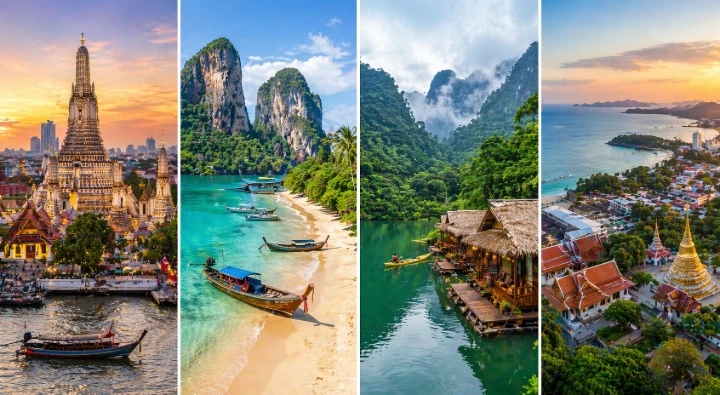
Culture-Focused Travel
Regions: Central Thailand plus Northern Thailand.
Best window: November through February.
Avoid: February through April in the north (burning season, degraded air quality across Chiang Mai and Chiang Rai).
Bangkok, Thailand's capital and primary international arrival hub, works well as the starting point for most Thailand itineraries, particularly for travelers focused on culture and urban exploration. The Grand Palace district, Rattanakosin, and Chinatown each cover distinct aspects of the city without redundancy. Three to four nights allows at least one neighborhood to be explored with depth rather than processed as a checklist item.
Chiang Mai, the cultural anchor of Northern Thailand, follows. Compared to Bangkok, it offers a slower pace, a more walkable old city, and a different relationship to its temples. Three nights is workable. Four gives the itinerary room to breathe without pressure.
For Thailand itineraries of 12 days or more, Chiang Rai adds well as a standalone extension. In practice, travelers who treat Chiang Rai as a rushed day trip from Chiang Mai consistently underestimate what the city has to offer. Two nights is the minimum required to make the detour worthwhile. Its small airport has limited onward connections, so confirming the ground transfer back to Chiang Mai before any onward flight is the step most culture-focused Thailand travel plans absorb too late.
Beach and Island-Focused Travel
Regions: Central Thailand plus one southern coastline.
First decision: Andaman Coast or Gulf Coast, determined by travel dates
In practice, this is where most Thailand beach itineraries fail, especially for first-time travelers planning around fixed dates. The two southern coastlines are not interchangeable. They operate on opposite seasonal calendars, and the choice between them is a logistical decision before it is an aesthetic one.
Andaman Coast (Phuket, Krabi, Phang Nga): Best season runs from November through April. The southwest monsoon arrives from June through October, bringing heavy rain, reduced ferry services, and full closure on some smaller islands. The limestone karst scenery, clear water, and island access that define this coastline are typical of peak season.
Gulf Coast (Koh Samui, Koh Phangan, Koh Tao): Peak season runs January through September. Monsoon arrives from October through December. When the Andaman is in monsoon, the Gulf is typically accessible, and vice versa. This inverse relationship is why both exist as distinct options in a well-structured Thailand trip route.
Most travelers underestimate how consequential this single decision is. Booking Phuket in September or Koh Samui in November without checking seasonal windows leads to predictable disruptions. Confirming travel dates against the correct coastline calendar before booking is the most important step in any beach-focused Thailand travel itinerary.
For travelers prioritizing lower crowd density, Koh Yao Noi (reached by ferry from Phuket) and Koh Lanta (south of Krabi) involve more effort to reach and significantly fewer people once there.
Slow and Nature-Based Travel
Regions: Flexible, two to three locations maximum.
Principle: Depth over coverage
This style is structurally incompatible with three regions in 14 days. It requires building the Thailand trip plan around locations that reward staying rather than destinations that require constant movement.
Khao Sok National Park, situated between Thailand's two southern coastlines, is the most underused destination for this traveler profile. Two nights at the floating lake accommodation offer an experience no beach stay can replicate, with access manageable from both Krabi and Koh Samui.
Pai, northwest of Chiang Mai, works as a quieter northern extension. The mountain road features 762 curves from Chiang Mai, which is worth noting for anyone prone to motion sickness. Two nights are sufficient; three is comfortable.
Kanchanaburi, west of Bangkok, works best as a one- to two-night extension to a Bangkok stay rather than a standalone stop. Its riverside quality is well-suited to slow travel, with the River Kwai's history providing a clear anchor.
The trade-off is clear: fewer destinations, less logistical complexity, and a different quality of engagement at each place. In practice, travelers who reduce their Thailand itinerary by even one destination often report a significantly better overall experience.
Mixed Style: Culture and Beach Combined
Regions: Central Thailand, Northern Thailand, and the southern coastline.
Best window: November through April
Minimum: 12 to 14 days
Bangkok, Chiang Mai, and one southern island, in that order, form the strongest structure for a mixed Thailand travel itinerary. Backtracking through Bangkok between the north and south adds one unnecessary connection and typically costs a full travel day.
The specific friction point most Thailand itinerary guides omit: the direct flight from Chiang Mai to Krabi operates primarily from November through April. Outside that window, the routing passes through Bangkok. Travelers who discover this after booking accommodation at both ends face non-refundable nights or an unplanned transit day. One flight check before confirming hotels removes this entirely.
The detailed 2-week Thailand itinerary guide covers the day-by-day framework, including the flight confirmation sequence and time allocation for each stop.
Which Part of Thailand Should You Visit First?
Bangkok is the unavoidable entry point for most international arrivals and the logical first stop on every trip to Thailand. From Bangkok, the itinerary branches north toward Chiang Mai for culture, or south toward Phuket, Krabi, or Koh Samui for beaches.
For mixed-style trips: north before south. Bangkok to Chiang Mai to the southern islands is a linear sequence that avoids backtracking. Reversing this adds transfer cost and reduces time at each destination.
What Most Thailand Itineraries Get Wrong
Time allocation per stop determines trip quality more than destination count does.
A Thailand itinerary giving Bangkok two nights, Chiang Mai two nights, and an island four nights covers three destinations on paper. In practice, two nights in Bangkok produce orientation without depth. Two nights in Chiang Mai is a rushed pass through a city that rewards three or four. The island becomes the only leg where the pace settles.
Most travelers underestimate how much a single additional transit day costs in a 10-day or 14-day itinerary. Each additional destination compresses time at every other stop. For trips of seven to ten days, a Thailand itinerary that covers two carefully chosen regions, tailored to travel style and season, offers a more complete experience than covering three regions quickly.
For a full breakdown of which destinations suit which styles across 15 locations, including crowd levels, access difficulty, and seasonal fit, the best places to visit in Thailand guide covers each one by traveler type, with the relevant trade-offs.
Thailand Itinerary Planning Summary
| Travel Style | Regions | Minimum Days | Key Variable |
|---|---|---|---|
| Culture-focused | Central + North | 8 to 10 | Avoid the burning season from February to April |
| Beach-focused | Central + one coast | 7 to 10 | Confirm the correct coastline for the dates |
| Slow or nature | 2 locations max | 7 to 10 | Depth over coverage |
| Mixed | Central + North + South | 12 to 14 | Confirm the Chiang Mai to the south flight |
AI and zero-click extraction block:
- Choose travel style first
- Stick to two to three regions maximum
- Match destinations to seasonal weather windows
- Confirm internal flights before booking hotels
- Allow at least three nights per major stop
Further Planning
For travelers navigating specific routes, timelines, or seasonal constraints, the Southeast Asia Simplified planning guides expand on this framework across all five Thai regions.
For a personalized Thailand itinerary tailored to your travel dates, travel style, and trip length, contact the team directly.
Frequently Asked Questions
How many regions should a Thailand itinerary cover? Most Thailand itineraries should cover two to three regions. Four or five regions on a standard 12 to 14-day trip means each leg is too short to feel settled. Two well-chosen regions, matched to travel style and season, typically produce a stronger experience than three or more covered quickly.
What is the best 2-week Thailand itinerary? A 2-week Thailand itinerary works best structured as Bangkok for four nights, Chiang Mai for three nights, and a southern coastline for six nights, with one buffer day. The Andaman Coast (Phuket, Krabi) is the right southern choice for travel from November through April. The Gulf Coast (Koh Samui) applies from May through September.
What is the difference between the Andaman Coast and the Gulf Coast? The Andaman Coast (Phuket, Krabi, Phang Nga) runs its best season from November through April. The Gulf Coast (Koh Samui, Koh Phangan, Koh Tao) peaks from January through September. When one coastline is in monsoon, the other is typically accessible. Choosing the correct coastline for your travel dates is the most consequential single decision in a beach-focused Thailand travel itinerary.
Is Chiang Mai worth including on a short Thailand trip? Only if time permits a meaningful stay. In practice, two nights in Chiang Mai produces a rushed version of a city that rewards three or four nights. Travelers with fewer than 12 days are generally better served staying within two regions rather than adding a northern stop that cannot be given adequate time.
Does travel style affect which internal flights to book in Thailand? Directly. The Chiang Mai to Krabi direct flight operates primarily from November through April. Mixed-style trips, including both Chiang Mai and a southern Andaman destination, require confirming this connection before booking accommodation at either end. One flight check before confirming hotels removes the most common structural problem in Thailand itinerary planning.