
The default Chiang Mai planning advice pushes travelers toward the Old City. Stay inside the moat, the logic goes, and everything is within walking distance. That framing works for one type of trip. It becomes a problem when it leads to an evaluation of Four Seasons Chiang Mai as a compromised base camp.
Distance from the city is not a drawback here. Distance is the feature.
No other five-star property in Thailand uses active agricultural land as a core element of the guest experience. Four Seasons Chiang Mai sits in Mae Rim Valley, 16 kilometers from the Old City, inside a working rice farm. The landscape changes month to month: rice shoots in June, paddies fully green by August, harvest by November. This goes beyond decorative landscaping with a mountain backdrop. It is the point of the property.
The decision this resort forces is simpler than it appears: is the stay built around the property or the city? That single answer determines whether Four Seasons Chiang Mai delivers at its price point or frustrates at it.
The Direct Answer
Four Seasons Chiang Mai is worth the price when the stay is structured as a retreat. The agricultural setting, the service precision, the cooking and wellness programming, and the privacy architecture of the pool villas combine to create an experience that no urban Chiang Mai property can replicate. The trade-off is geographic commitment. Guests who treat it as a base for daily city exploration will spend a meaningful portion of each day in transit and pay premium rates for the privilege.
If leaving the resort more than once per day is the plan, this is not the right property.
| If the priority is... | Fit |
|---|---|
| A private retreat with agricultural immersion | Strong fit |
| A pool villa with a high-ratio managed service | Strong fit |
| Cooking school, spa, and wellness in one setting | Strong fit |
| Daily access to the Old City's temples and markets | Wrong property |
| Walking distance to street food and nightlife | Wrong property |
| Independent movement without pre-arranged transport | High friction fit |
What Four Seasons Chiang Mai Actually Is
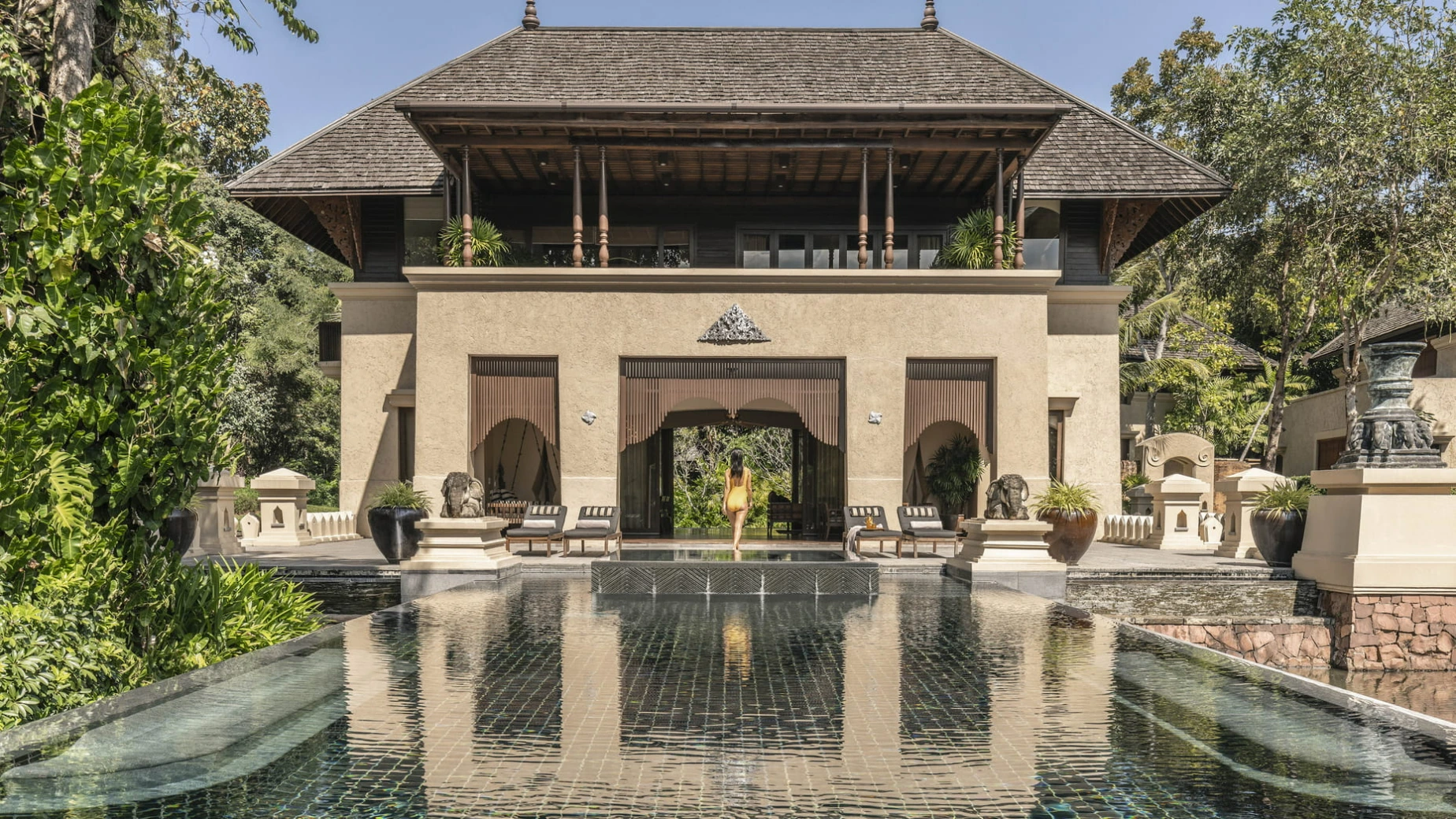
The resort sits in Mae Rim Valley at an elevation of approximately 400 meters, surrounded by active rice paddies, lotus ponds, and forested hills that frame Doi Suthep to the south. It was designed to reference a traditional northern Thai village, with Lanna architectural language running through every structure: polished teak floors, carved detailing, Thai cotton textiles, and covered outdoor salas attached to each room.
What defines the experience at this property:
- Working rice paddies, not decorative landscaping
- Lanna architecture is consistent across all structures, not applied as a theme
- 98 rooms total, maintaining a high service ratio at full occupancy
- Programming tied to the agricultural calendar rather than a fixed activity schedule
- KHAO restaurant and cooking school sourcing from an on-site organic garden
That last point matters for understanding what sets this property apart from luxury resorts that simply offer a mountain view. The connection to the land is operational. Guests can plant rice shoots, wash buffalo, and participate in traditional crafts at the Chaan Baan cultural courtyard. The Bill Bensley-designed teak house that houses KHAO restaurant and the cooking school exists because the property built its culinary identity around northern Thai Lanna cuisine specifically, not Thai cuisine more broadly.
Peak-season occupancy is absorbed into the landscape itself. At 98 rooms, the scale is intentionally small for a Four Seasons, and the grounds provide separation that a denser property cannot manufacture.
Compared to Chiang Mai's city-based luxury hotels, this property trades location convenience for environmental control, service depth, and privacy at a scale the Old City cannot provide.
If Chiang Mai is one stop on a broader northern route, the Thailand 2-Week Itinerary guide covers how to sequence northern and southern Thailand without wasting time on poor routing.
Room Selection: What to Book and Why It Matters
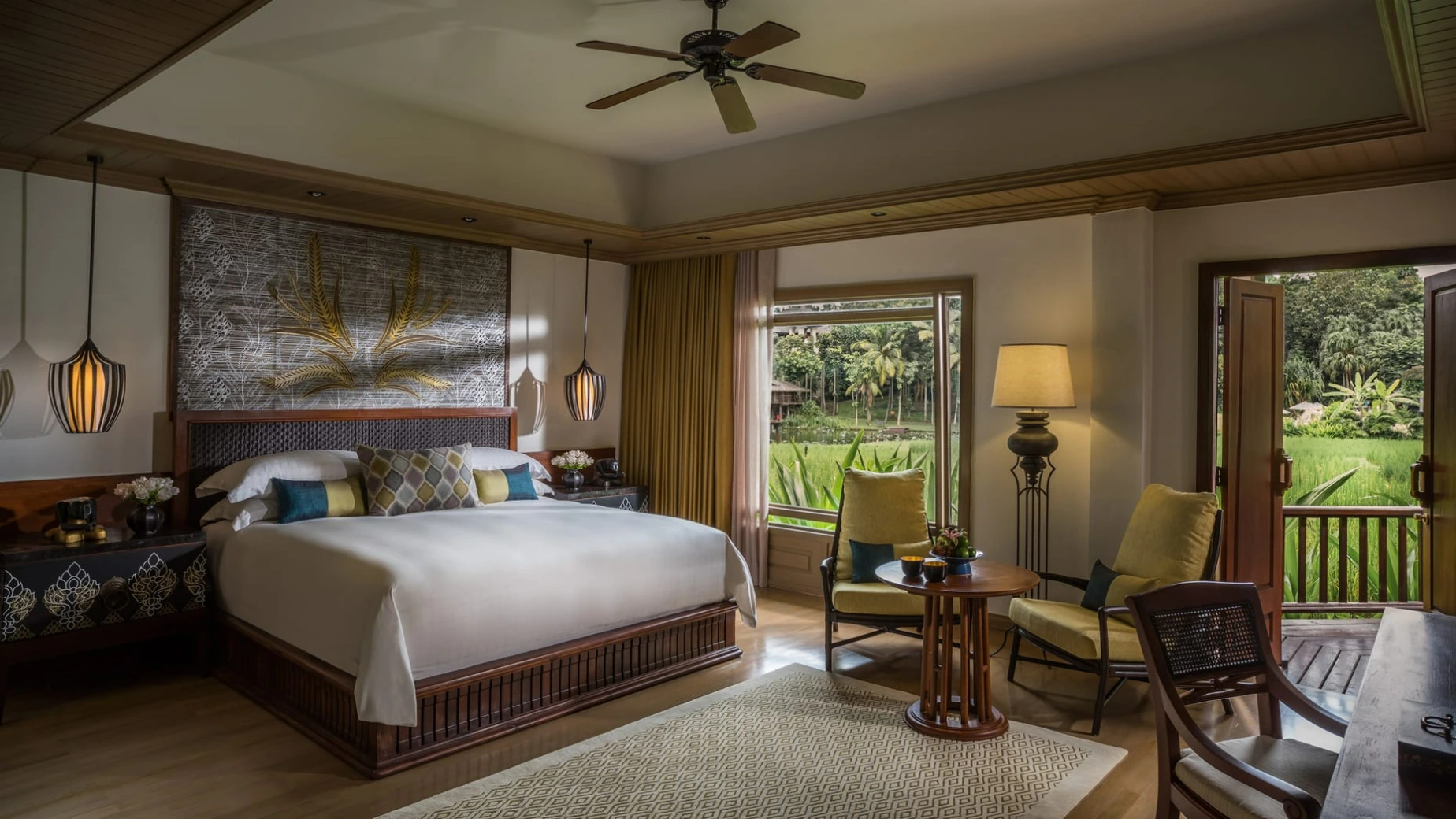
Choosing the wrong room tier here is the most avoidable planning error. The difference between a ground-floor Garden Pavilion and an Upper Rice Terrace Pavilion is not luxury grade. It is view access. At this resort, access to views is the primary experiential variable.
| Room Type | Best For | Key Operational Detail |
|---|---|---|
| Garden Pavilion | First-stay, entry price point | Private Thai sala terrace, garden-level, no pool |
| Upper Rice Terrace Pavilion | Views as the priority | Panoramic rice paddy and Doi Suthep sightlines, vaulted ceiling, two-story cluster of four |
| One-Bedroom Pool Villa | Couples, privacy as the priority | 24 sqm private pool, surrounded by water on three sides, outdoor shower |
| Two-Bedroom Pool Villa | Families or extended-stay pairs | Expansive outdoor lounge, private pool, Lanna-style interiors |
| Two or Three-Bedroom Residence | Groups, milestone travel | Dedicated Residential Assistant, private pool, fireplace |
| Four-Bedroom Owner's Residence | Large group or complete privacy | Personal chef, personal assistant, airport transfer, complimentary resort activities included |
Upper-level pavilions solve the view problem that ground-floor rooms do not. For any stay where the landscape is the reason for being there, the price difference between tiers is justified. For couples who prioritize seclusion over views, the one-bedroom pool villa, surrounded by water on three sides, is the cleaner choice.
One operational detail that applies to all categories: notify the resort of arrival time in advance. Golf cart transfer to the room is standard from check-in. The property is large enough that golf carts are required for most movement between areas. Early arrival access requires booking the prior night. Without it, access to the room before 3:00 PM is not guaranteed, though bags can be stored and fitness facilities can be used.
What the Stay Includes: Experiences to Book Before Arrival
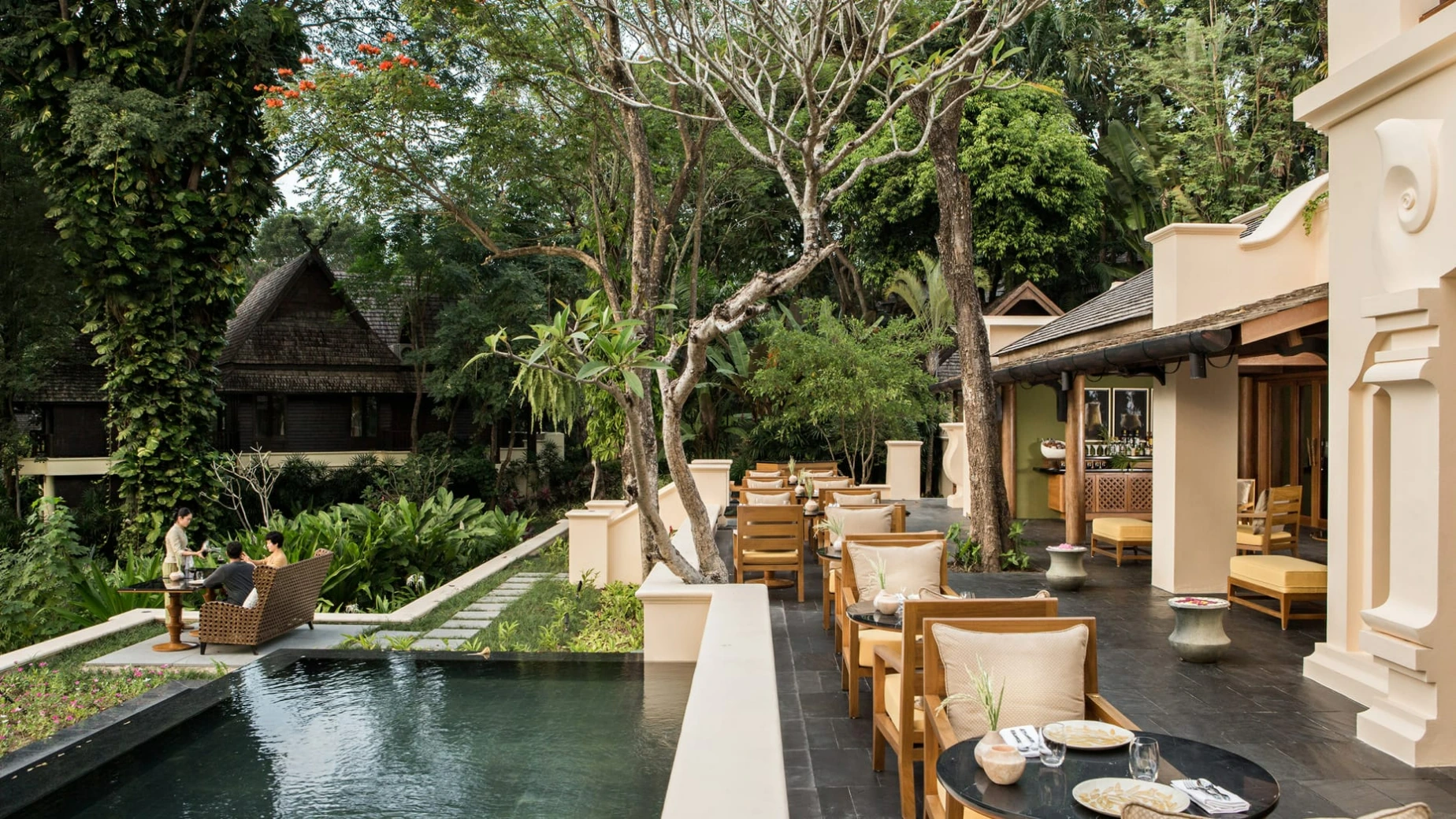
The on-property programming is so extensive that a 3- to 4-night stay can be fully structured without leaving the resort. The following carry separate charges and book out during peak season. Reserving before arrival, not at check-in, is the correct approach.
KHAO Restaurant and Cooking School. Housed in a Bill Bensley-designed teak house, this covers northern Thai Lanna cuisine through technique rather than demonstration. Classes draw from the organic garden and address dishes specific to northern Thailand, distinct from Bangkok-style cooking. Book before arrival during November through February.
Wara Cheewa Spa. Full-service offerings include couples treatments, hydrotherapy, and yoga overlooking the rice fields. Yoga and fitness classes incur a per-session surcharge in addition to the room rate. The main communal pool is unheated, which is a practical consideration during December and January, when cool-season morning temperatures drop to 12-15°C.
Agricultural and Cultural Programming. Rice planting, buffalo washing, natural dyeing, and pottery are available through the Chaan Baan courtyard. These operate according to the property's agricultural calendar, not a fixed guest timetable.
Day Excursions from the Property. Doi Inthanon National Park, home to Thailand's highest peak at 2,565 meters, is a 3-hour drive away. Baan Mae Kampong, a heritage village known for fermented tea and century-old traditions, is 1 hour. Both require advance arrangement through the concierge. Neither is it practical as a spontaneous morning decision.
A few observations that only become apparent during a stay: mornings in Mae Rim are typically clear before afternoon cloud buildup, making early activities the priority in wet-season months. Evenings are quiet by design, with most on-property dining concluding without late-night extensions. The property is built for travelers who want contained quality, not for those who want the option to step out.
When deciding what to pair with this stay in northern Thailand, the luxury Thailand travel experiences guide covers curated options across the region worth building around the resort.
Getting There: Airport Transfer and Access Logistics
Chiang Mai International Airport (CNX) to the resort is approximately 25-40 minutes by car, depending on the time of day. The resort address is 502 Moo 1, Mae Rim-Samoeng Old Road, Mae Rim, Chiang Mai 50180.
The resort offers an airport transfer service with advance notice; surcharges apply and must be confirmed at the time of booking using the contact details in the reservation confirmation. Independent private transfer from CNX is equally straightforward.
The Old City is 30 to 45 minutes by road under normal conditions. On-demand transport is not available from the property. Each city excursion requires advance arrangement through the concierge or an independently booked vehicle. For any stay where Old City access is planned more than once or twice, transport time and cost should be treated as a real budget and scheduling variable, not an incidental.
Transfer options from Chiang Mai International Airport, including private car and shared services, are covered in the Thailand airport transfer guide.
Pricing: What to Realistically Budget
Rates below reflect general market ranges. Live pricing varies by date, room category, and booking platform. Taxes are not included.
| Category | Estimated Nightly Range (USD) |
|---|---|
| Garden Pavilion | From 600 to 800 (low season) |
| Upper Rice Terrace Pavilion | From 750 to 1,000+ |
| One-Bedroom Pool Villa | From 900 to 1,300+ |
| Two or Three-Bedroom Residence | Price on request |
| Four-Bedroom Owner's Residence | Price on request, includes chef, assistant, and airport transfer |
| Buffet breakfast (if not included) | THB 1,177 per adult |
| Spa treatments | Additional charge varies by service |
| Cooking classes | Additional charge, book in advance |
| Yoga and fitness classes | Surcharge per session |
One honest limitation: food and beverage pricing at the property runs high relative to the surrounding Mae Rim area, and there are no meaningful dining alternatives within walking distance. Planning for full-on-property dining throughout the stay is the realistic approach.
Third-party platform data from recent booking windows shows nightly rates landing around USD 1,298 at the entry level. March and October tend to be lower-rate periods. Peak pricing from December through February reflects both demand and the strongest seasonal conditions.
Best Time to Stay: Seasonal Trade-offs That Matter Here
Northern Thailand has a seasonal variable that most southern Thailand planners ignore: the burning season. This is not a minor consideration for a resort whose primary value lies in landscape visibility and the quality of the outdoor experience.
| Period | Conditions | Verdict for This Property |
|---|---|---|
| November to mid-February | Cool and dry, 12 to 28°C, clear Doi Suthep views, peak rates | Strongest window |
| Mid-February to April | Burning season: PM2.5 smoke, mountain views obscured, up to 40°C by April | Avoid, especially with respiratory sensitivity |
| May to October | Wet season: afternoon rain, rice paddies at visual peak, lower rates | Viable and underrated |
The burning season removes this resort's landscape advantage entirely. The Doi Suthep views disappear behind a smoke haze, the grounds dry out, and temperatures reach levels that substantially reduce time spent outdoors. For a property built around its setting, February through April is the one window where the core value proposition weakens.
June through September produces the most visually complete version of the property. Rice paddies are full, green, and actively farmed. Mountain views are clear. Rates are lower. Afternoon rain arrives in short bursts rather than all day, and mornings are typically clear enough for outdoor programming. This window is consistently underestimated by travelers, defaulting to the cool-season peak.
November is the strongest single month for combining property conditions with cultural timing: cool temperatures, clear skies, and the Yi Peng lantern festival season in Chiang Mai city. Festival access from the resort requires a 30- to 45-minute drive each way, which needs to be scheduled as part of the evening, not as an afterthought.
Who This Property Is Right For, and Who It Is Not
Right for:
- Retreat itineraries where the resort is the destination, not the base
- Couples in pool villas: honeymoon, anniversary, or extended private stay
- Wellness-focused travel combining spa, yoga, cooking, and agricultural immersion
- Families using residence configurations (kids club available, multiple villa layouts accommodate children without compromising adult space)
- Northern Thailand itineraries combining the resort with Doi Inthanon or Chiang Rai as a day or overnight excursions
Not right for:
- Itineraries built around daily Old City temple visits, night markets, and street food exploration
- Independent travelers wanting to move without pre-arranged transport
- Anyone with respiratory conditions traveling between February and April
- One-night stops where the property's depth cannot be accessed
A note on the northern Thailand luxury market: this is the only property in the region operating at this specific combination of scale, agricultural authenticity, and Four Seasons service infrastructure. The Mandarin Oriental Dhara Dhevi was its primary historical comparison point in the Chiang Mai luxury market; that property's current operational status warrants independent verification before planning around it.
Before committing to a routing sequence, see how the north fits into the full picture in the "Best Places to Visit in Thailand" guide.
FAQ
Is Four Seasons Chiang Mai worth the price?
Yes, for stays structured as retreats. The pricing reflects a property with genuine agricultural depth, a high service ratio across 98 rooms, and programming that delivers across cooking, wellness, and cultural immersion. It does not justify the rate for stays built primarily around access to Chiang Mai city.
What is the best room to book at Four Seasons Chiang Mai?
For couples: the one-bedroom pool villa. The 24 sqm private pool and water-surrounded setting deliver the privacy and landscape connection that the property is built around. For views without a private pool: the Upper Rice Terrace Pavilion. The panoramic views of the rice paddy and Doi Suthep from the upper level are a material upgrade over the garden-level rooms.
How far is Four Seasons Chiang Mai from the Old City?
16 kilometers, translating to 30 to 45 minutes by car under normal conditions. The resort does not operate on-demand transport. Each visit to the Old City requires advance arrangements. If city access is planned more than once or twice during the stay, budget transport as a real scheduling and cost variable.
What is the best time of year to stay?
November through mid-February for clear skies, cool temperatures, and full visibility of the landscape. June through September for lower rates, full rice paddies, and clean air. February through April should be avoided due to the burning season, which degrades air quality and obscures the mountain views around the property.
Does Four Seasons Chiang Mai include breakfast?
Not automatically in standard room rates. Buffet breakfast is available at THB 1,177 per adult when not included. Some booking packages include breakfast; confirm at the time of reservation. Residence categories carry additional inclusions that vary by villa tier.
How does this compare to a luxury city hotel in Chiang Mai?
They solve different problems. A luxury city hotel in the Old City offers easy walking access to temples, markets, and restaurants, with low reliance on transport. Four Seasons Chiang Mai offers a contained retreat with landscape, service depth, and privacy that no urban property can match. The decision is not which is better. It is what aligns with the structure of the planned trip.
Conclusion
Four Seasons Chiang Mai resolves the northern Thailand luxury question cleanly for one type of traveler: someone who commits to Mae Rim Valley as the experience rather than treating it as a staging point for the city. The Lanna architecture, working rice paddies, high-ratio service across 98 rooms, and the depth of culinary and wellness programming make it the benchmark luxury resort in northern Thailand. The geographic distance from the Old City is not a limitation to manage. It is the design choice that makes everything else possible.
This is not a better version of Chiang Mai. It is a different way to experience it entirely.
For broader Thailand luxury travel planning, the Thailand luxury travel overview provides the full regional picture. For pre-departure operational planning, the Thailand travel tips guide covers visa, currency, and logistics specifics.