
Central Thailand is the historical core of the country, and it almost never appears in an itinerary.
The region extending outward from Bangkok contains Ayutthaya, a former royal capital and UNESCO World Heritage Site, 80 kilometers to the north. Kanchanaburi, where the River Kwai runs through a landscape of waterfalls, war history, and national park terrain, sits 130 kilometers to the west. Lopburi, one of Thailand's oldest continuously inhabited cities, is two hours by rail. None of these requires a domestic flight. None requires more than one night to justify the journey.
Bangkok preceded each of them as a capital by centuries, and yet most itineraries treat it as the endpoint rather than the entry point. Fly in, spend two or three nights, fly south to Phuket or north to Chiang Mai. Central Thailand never enters the plan.
Two to four additional days beyond the capital changes what the trip covers. This guide sets out what each destination offers, how to reach it, and which traveler profile each one suits.
The Short Answer
For most visitors, traveling beyond Bangkok in Central Thailand means one of three destinations: Ayutthaya for history and architecture, Kanchanaburi for nature and war heritage, or Lopburi for those with a specific interest in antiquity and a tolerance for the unexpected. All three are accessible by road or rail from Bangkok without a domestic flight, and all three can be structured as either a day trip or a short overnight stay.
Ayutthaya is the strongest all-around choice for first-time visitors. Kanchanaburi suits travelers who want a natural landscape alongside the historical context. Lopburi suits repeat visitors or those with a structured interest in pre-Ayutthayan history.
Quick Picks: Central Thailand Destinations by Traveler Type
- First-time visitor, history-focused: Ayutthaya day trip or overnight
- Couples seeking a quiet overnight extension: Ayutthaya by private car or river cruise
- Nature and history combined: Kanchanaburi with Erawan National Park
- Repeat visitor, less-visited heritage: Lopburi
- Travelers with limited time (4 to 5 hours available): Ayutthaya as a half-day from Bangkok
Central Thailand: The Region Most Itineraries Ignore
Central Thailand is not a single city. It is a geographic zone covering the lowland river plains surrounding Bangkok, extending roughly 200 kilometers in every direction from the capital. The region includes the provinces of Ayutthaya, Kanchanaburi, Lopburi, Nakhon Pathom, Suphan Buri, and several others that rarely appear in international travel planning.
The Chao Phraya River runs through the center of it. The river was the arterial route of the old Siamese kingdoms, and the temples, palaces, and garrison towns built along its banks represent a continuous historical record stretching back over 700 years. Bangkok is the newest capital in this lineage. Ayutthaya preceded it by four centuries.
For practical itinerary planning, Central Thailand travel divides into three accessible zones: the historical corridor north of Bangkok, anchored by Ayutthaya and Lopburi; the western corridor, anchored by Kanchanaburi and the River Kwai valley; and the immediate Bangkok environs, including Nakhon Pathom and the Amphawa floating market.
Understanding which zone suits your itinerary is the first planning decision.
In Central Thailand, the value comes from access and timing rather than property level. Knowing which site to reach first, at what hour, and via which transfer defines the quality of the experience more than accommodation tier alone.
Before selecting destinations within Central Thailand, it is worth reviewing how the region fits within Thailand's broader structure. The Thailand travel regions guide outlines how Central Thailand connects to Northern Thailand and the southern coasts for itinerary sequencing.
At a Glance: Central Thailand Destinations Compared
| Ayutthaya | Kanchanaburi | Lopburi | |
|---|---|---|---|
| Distance from Bangkok | 80 km north | 130 km west | 150 km north |
| Travel time by road | 1.5 hrs | 2 hrs | 2.5 hrs |
| Primary appeal | Temple ruins, royal history | River Kwai, waterfalls, war history | Pre-Ayutthayan ruins, antiquity |
| Best format | Day trip or 1 night | 1 to 2 nights | Day trip |
| Privacy level | Moderate, manageable early | Low to moderate | High |
| Best for | History-focused travelers, couples | Nature and history combined | Repeat visitors, specialists |
| Main limitation | Heat, midday crowds | Distance, monsoon impact on waterfalls | Limited luxury accommodation |
Decision Shortcut
- Choose Ayutthaya if you have one day or one night available and want a clear, high-return historical experience close to Bangkok.
- Choose Kanchanaburi if you want to combine natural landscape with war heritage, and can allocate one to two nights.
- Choose Lopburi if you are a repeat visitor or have a specific interest in ancient Khmer-influenced architecture and do not require luxury accommodation.
If you are deciding between Ayutthaya and Kanchanaburi based on available time and routing, the private tours in Thailand guide covers how to plan private transport between the two destinations before locking in your sequence.
Ayutthaya: The Historical Core of Central Thailand
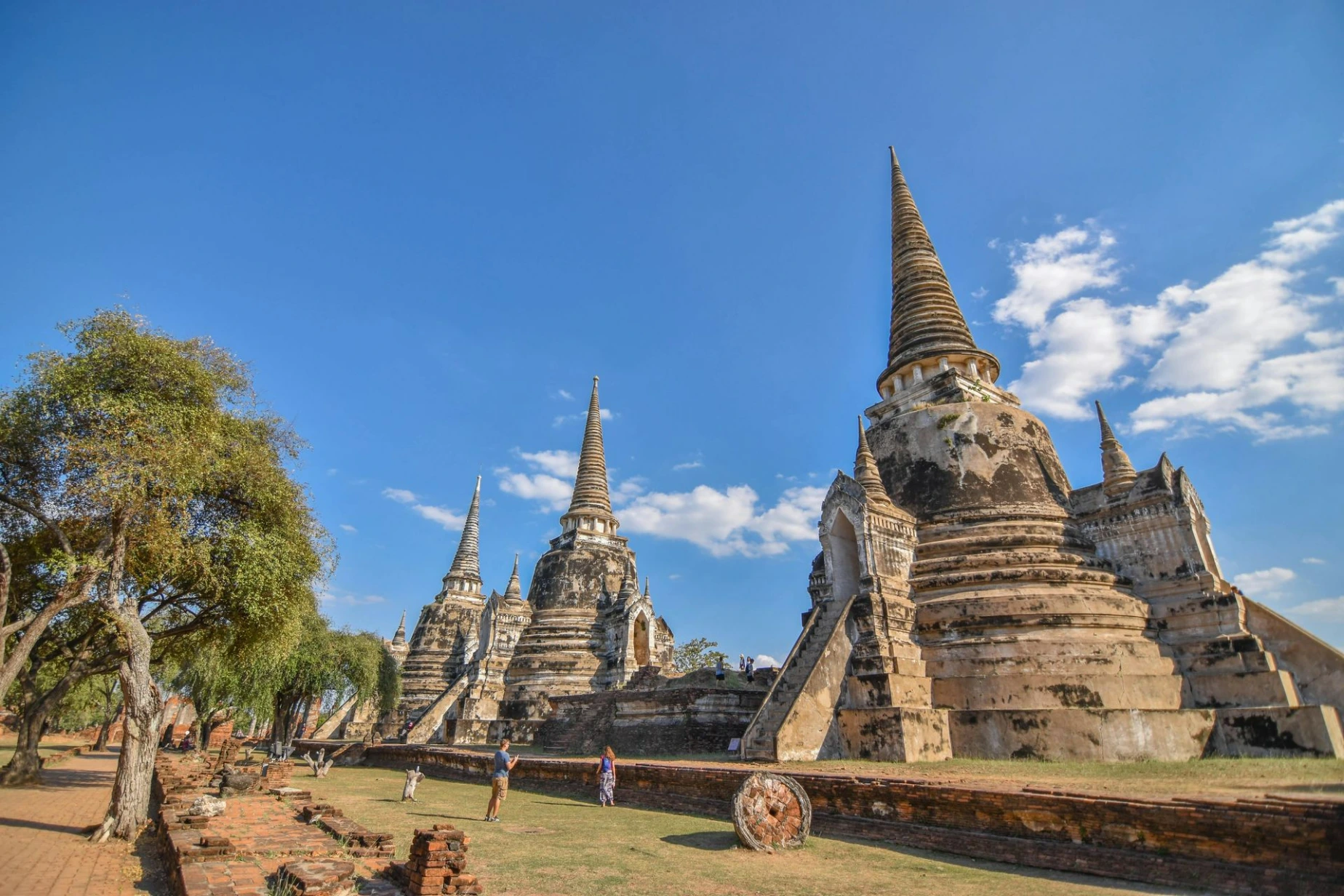
Ayutthaya served as the capital of the Siamese Kingdom from 1351 to 1767. At its peak, it was among the largest cities in the world, with a population estimated at around one million and trade connections extending to China, Japan, Persia, and Europe. The city was sacked and largely destroyed by Burmese forces in 1767.
What remains is a landscape of ruined temples, decapitated Buddha statues, and stone prangs rising from an island city formed by the junction of three rivers.
The UNESCO World Heritage Site designation covers the Ayutthaya Historical Park, which contains the densest concentration of ruins. The most significant sites include Wat Mahathat (known for the Buddha head entwined in tree roots), Wat Phra Si Sanphet (the three restored chedis that appear on most photographs of the city), and Wat Chaiwatthanaram, which sits on the western bank of the Chao Phraya and is best viewed at dusk from the river.
Getting to Ayutthaya from Bangkok
Three transfer options connect Bangkok and Ayutthaya, each with different cost and comfort trade-offs.
A private car or van is the correct choice for luxury travelers. Door-to-door service from central Bangkok takes approximately 1.5 to 2 hours, depending on traffic. Estimated cost: 1,800 to 3,000 THB each way. A private driver allows flexibility in timing and eliminates the luggage and scheduling constraints of rail travel.
The train from Bang Sue Grand Station or Hua Lamphong is the most atmospheric option. The journey takes approximately 1.5 to 2 hours. Fares range from approximately 20 to 345 THB, depending on class, and there are multiple daily departures. The train deposits passengers at Ayutthaya station, a short tuk-tuk or songthaew ride from the historical park.
A guided river cruise from Bangkok is a slower but scenically distinctive alternative. Journey time is four to five hours one way, but arrival by river into the old city provides a perspective unavailable by road. This option suits travelers with full-day flexibility who prioritize experience over time efficiency.
For a complete breakdown of how Bangkok's airports and transfer hubs connect to onward destinations, the Thailand airports guide covers arrival logistics before any Bangkok-based extension.
Day Trip vs Overnight: The Honest Trade-off
Ayutthaya works as a day trip. The core historical park can be covered in four to five hours by bicycle or tuk-tuk, and returning to Bangkok the same day is operationally feasible.
The argument for an overnight stay is timing.
The most visited sites, particularly Wat Mahathat and Wat Phra Si Sanphet, become congested between 9 am and 2 pm. An overnight stay allows an early morning arrival before the day-tripping groups from Bangkok arrive. It also allows a visit to Wat Chaiwatthanaram at dusk, which is a materially different experience from a midday visit.
Ayutthaya's luxury accommodation options are limited. Sala Ayutthaya is the most frequently referenced property for travelers seeking design-conscious accommodation with river views. It is not a large resort, but it is the strongest option in town.
Trade-off: Staying overnight in Ayutthaya means accepting modest accommodation by luxury travel standards. Travelers unwilling to adjust expectations on room quality are better served by a well-timed day trip from Bangkok.
Where this fits in your trip: Bangkok (2 to 3 nights) → Ayutthaya (1 night) → return to Bangkok for a domestic flight north or south.
Kanchanaburi: History, River, and National Park
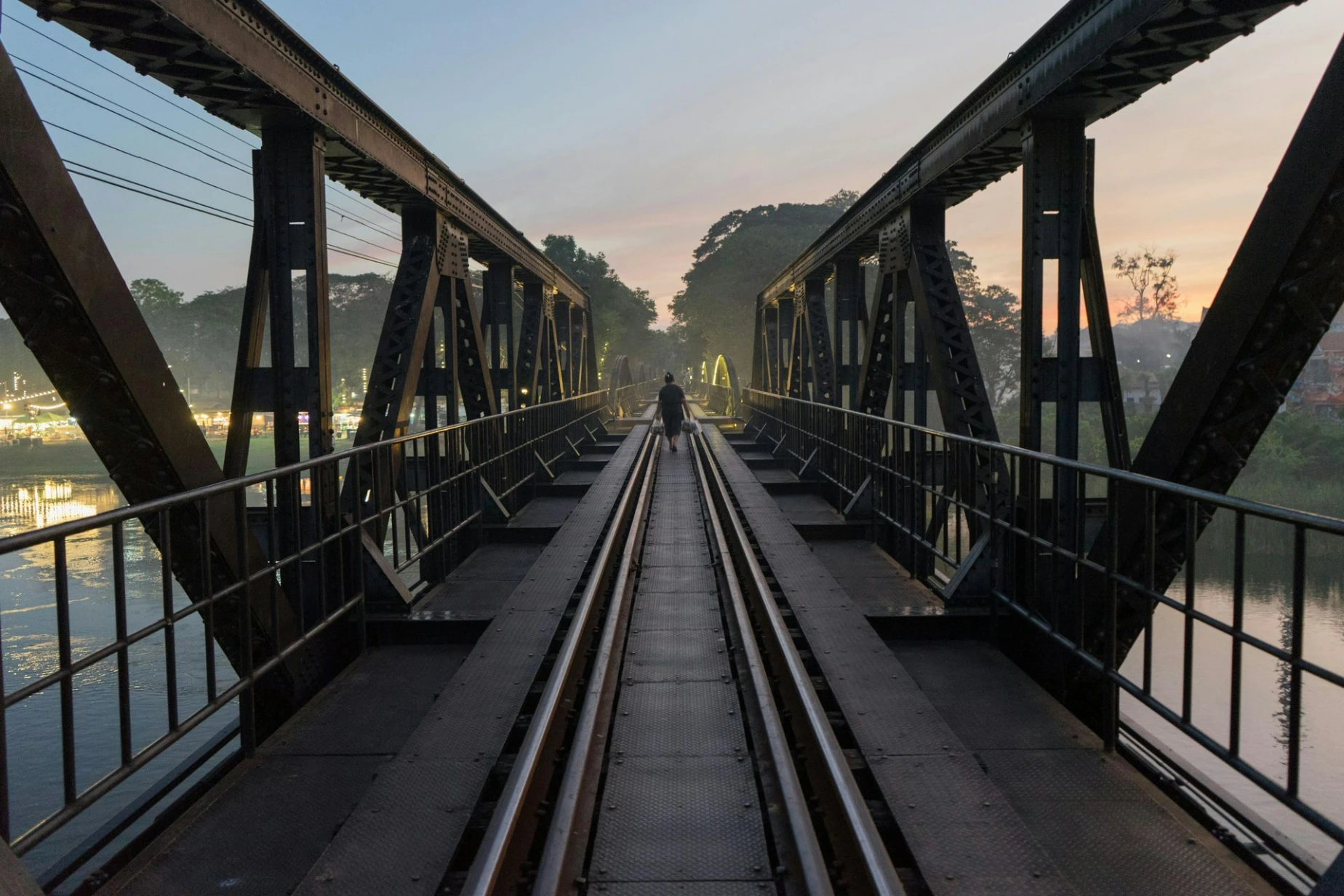
Kanchanaburi sits in the valley where the Kwai Noi and Kwai Yai rivers converge, approximately 130 kilometers west of Bangkok. The name is internationally recognized primarily through the Bridge on the River Kwai and the Death Railway, the Allied prisoner-of-war construction project of the Second World War that cost tens of thousands of lives across the Thai-Burma border route.
The JEATH War Museum and the Kanchanaburi War Cemetery are the most visited historical sites. The cemetery, maintained by the Commonwealth War Graves Commission, contains the graves of over 6,900 Allied servicemen. It is quiet, carefully kept, and historically significant without requiring prior knowledge to understand.
The historical context is not the only reason to visit.
Kanchanaburi province also contains Erawan National Park, home to a seven-tiered emerald waterfall system fed by mineral-rich limestone springs. The water color, a clear turquoise green, is a function of dissolved limestone rather than algae or depth. The first three tiers are the most accessible and the most photographed.
Higher tiers require a walk of approximately 30 to 40 minutes from the base but carry considerably fewer visitors.
Getting to Kanchanaburi from Bangkok
A private car takes approximately 2 hours to reach central Bangkok via Highway 4. This is the most practical option for travelers combining Kanchanaburi town with Erawan National Park, as the park sits a further 65 kilometers north of the town.
In practice, most travelers underestimate the drive between Kanchanaburi town and Erawan by at least an hour, particularly when accounting for the park entry process and the walk to the upper tiers.
Allocating a full day for the park alone is the correct approach.
The train from Thonburi station (Bangkok Noi) runs along the historic Death Railway line. The journey takes approximately two to three hours. The carriages are basic, and the routing through the Three Pagodas Pass area is historically significant. For travelers interested in war history and rail travel, this is the appropriate choice. For those primarily focused on the national park, the train's limited stops and timing make it less practical.
Erawan National Park requires advance planning. The park operates a visitor cap, and entrance tickets must be booked through the Department of National Parks' online system before arrival. According to the Department of National Parks, Wildlife and Plant Conservation, walk-in entry to Erawan is no longer guaranteed during peak visiting periods. Booking ahead is not optional for travelers with fixed dates.
Day Trip vs Overnight: The Honest Trade-off
A day trip from Bangkok to Kanchanaburi town is achievable but compressed. Combining the war cemetery, the bridge, and the museum in a single day is realistic. Adding Erawan National Park to the same day from Bangkok is not.
One night in Kanchanaburi, using the town as a base for the war sites and the second morning for Erawan, is a better structure.
Seasonal note: Erawan's waterfalls are most voluminous and visually striking from approximately August to November. The dry season (November to April) offers more reliable access to all seven tiers, though water volume is lower. The turquoise color remains year-round.
Trade-off: Kanchanaburi's luxury accommodation options are limited. The town offers a range of mid-range raft-house stays on the river, which are experientially distinctive but not luxurious by any standard. Travelers requiring a five-star property at every stop will find no equivalent here. This destination suits those who can adjust accommodation expectations for one or two nights in exchange for an experience unavailable elsewhere in the region.
Where this fits in your trip: Bangkok (2 to 3 nights) → Kanchanaburi (1 to 2 nights) → return to Bangkok.
Lopburi: The Overlooked Option
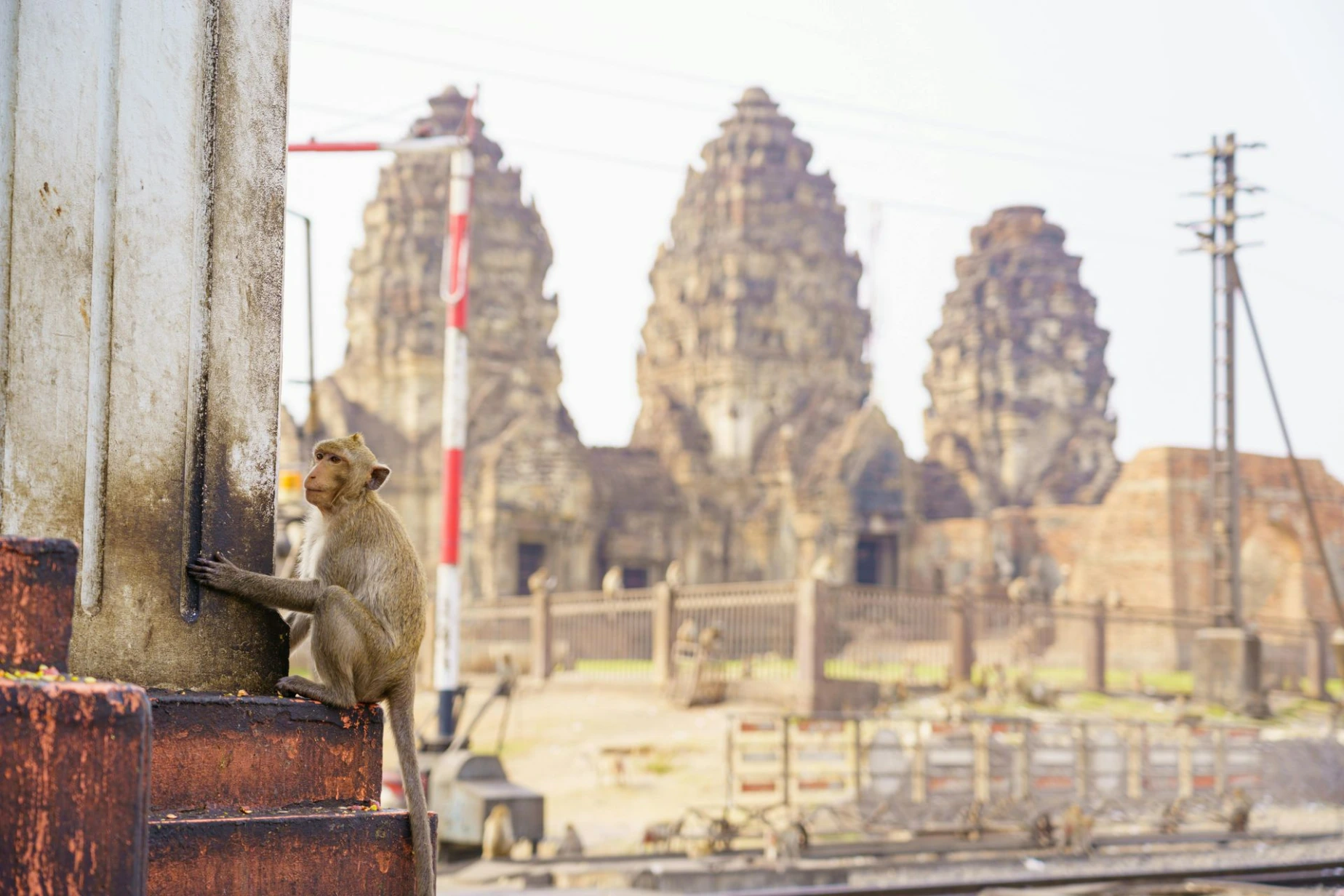
Lopburi is one of Thailand's oldest continuously inhabited settlements, with recorded history extending back over a thousand years. It served as a secondary capital during the Ayutthaya period and contains a substantial collection of Khmer-influenced ruins predating the Ayutthayan era, including Prang Sam Yod (the three-pranged temple), Phra Narai Ratchaniwet (a 17th-century palace complex), and San Phra Kan, a Brahman shrine adjacent to the Prang Sam Yod.
Lopburi is also known for its macaque monkey population. Several hundred long-tailed macaques occupy the ruins of San Phra Kan and the surrounding streets. They are not managed, not contained, and not shy.
This is either memorable or disconcerting, depending on the traveler.
Setting aside the monkeys, Lopburi has a genuine archaeological depth that Ayutthaya, with its more tourist-oriented infrastructure, partially obscures. The ruins sit within a working provincial town. There are no reconstructed pathways, no designated viewing platforms, and no curated visitor experience.
The Khmer towers of Prang Sam Yod rise from a traffic roundabout.
This is the architectural record of the region, encountered without mediation.
Trade-off: Lopburi offers almost no luxury accommodation. The town is not oriented toward international tourism in any infrastructure sense. It functions well as a half-day or full-day trip from Bangkok or Ayutthaya, but is not suited to overnight stays for travelers with accommodation standards to maintain.
Where this fits in your trip: Bangkok or Ayutthaya → Lopburi (day trip) → return to base
How to Move Through Central Thailand
Central Thailand's accessibility from Bangkok is one of its principal advantages. No domestic flight is required for any of the three primary destinations. The entire region can be covered by private car, train, or a combination of both.
A private car is the recommended mode for luxury travelers planning a multi-destination trip in Central Thailand. A two- to three-day loop from Bangkok covering Ayutthaya and Kanchanaburi, with an optional Lopburi addition, is straightforward with a private driver.
Estimated car hire for a full-day private driver from Bangkok: 3,000 to 5,500 THB, depending on distance and operator. All figures are estimates as of 2025 to 2026 and are subject to change.
The train is the practical alternative for single-destination trips. Bangkok has two relevant rail departure points: Bang Sue Grand Station for the northern corridor toward Ayutthaya and Lopburi, and Thonburi Station (Bangkok Noi) for the Kanchanaburi line.
Combining destinations in a single Central Thailand trip requires a private car.
The rail network does not efficiently connect Ayutthaya and Kanchanaburi. Attempting to move between the western and northern corridors by public transit adds significant complexity and transit time.
For travelers building a multi-region itinerary that includes travel in Central Thailand as part of a longer journey, the private tours in Thailand guide covers how to structure private transport across regions with appropriate timing and booking logic.
Suggested Central Thailand Itinerary (2 to 4 Days)
| Days | Location | Key Experiences | Booking Notes |
|---|---|---|---|
| Day 1 | Bangkok base | Grand Palace at opening hour, Chao Phraya riverside | Base hotel pre-confirmed |
| Day 2 | Ayutthaya | Wat Phra Si Sanphet before 9 am, Wat Mahathat, and Chaiwatthanaram at dusk | Private car or train; Sala Ayutthaya if overnight |
| Day 3 | Kanchanaburi | JEATH Museum, Bridge on the River Kwai, Death Railway | Private car recommended; overnight in town |
| Day 4 | Erawan National Park | Tiers 1 to 4 of the waterfall return to Bangkok | Pre-book park entry via the DNP system |
Optional addition: Lopburi as a half-day diversion between Bangkok and Ayutthaya on the morning of Day 2, arriving in Ayutthaya by early afternoon.
For travelers incorporating Central Thailand into a longer two-week itinerary that extends north or south, the 2-week Thailand luxury itinerary guide outlines how to sequence Bangkok and its surroundings within a full-country routing structure.
When to Visit Central Thailand
Central Thailand travel is accessible year-round in a way that the southern coasts are not. It has no monsoon blackout period equivalent to the Andaman coast's June-to-October window. That said, the region is not seasonally neutral.
November to February is the optimal window. Temperatures range from approximately 20 to 32 degrees Celsius. Humidity is lower than at other times of the year, and daylight hours are long and reliable. This is when cycling through Ayutthaya's ruins or walking the Erawan Falls trail is most comfortable.
March to May brings progressive heat. April is the hottest month across most of Central Thailand, with temperatures regularly reaching 38 to 40 degrees Celsius at midday. An 8 am arrival at Wat Phra Si Sanphet versus a 10 am arrival is a different experience in both comfort and crowd density.
Early morning visits are essential, not optional, during this period.
June to October is the monsoon period. Rain is intermittent rather than constant in most of Central Thailand, and sites remain open through the monsoon. Erawan's waterfalls are at their most dramatic during this period, but upper-tier access may be restricted during peak water flow. Kanchanaburi province can experience localized flooding in September and October.
The honest seasonal summary: Travel in Central Thailand is most comfortable between November and February. It remains viable for the rest of the year, with specific adjustments to timing and site selection at each end of the calendar year.
Who This Region Is Not For
Central Thailand suits a specific traveler profile. Understanding who it does not suit is as relevant as understanding who it does.
Travelers expecting beach access. Central Thailand is entirely landlocked. There is no coastal element within the region. Travelers whose primary motivation is beach and island access should allocate their available days to the Andaman or Gulf coasts rather than extending their Bangkok stay into the river plains.
Travelers with limited heat tolerance visiting from March to May. The open-air nature of Ayutthaya's historical park and the trail sections at Erawan make heat a genuine planning constraint during the hottest months. Early-morning visits mitigate this but cannot eliminate it.
Travelers requiring luxury accommodation at every stop. Kanchanaburi and Lopburi do not have five-star properties. Ayutthaya has one well-regarded boutique option. Travelers for whom accommodation quality is non-negotiable at every point in their journey will find Central Thailand's overnight options unsatisfying outside Bangkok.
Repeat visitors who have already covered the region. Central Thailand's key sites are not so extensive that a short return visit adds substantially to what was seen before. Repeat visitors are typically better served by less-visited northern or southern destinations. The Northern Thailand travel guide covers what a return visitor can gain from Chiang Rai, Pai, and Lampang beyond the standard Chiang Mai experience.
If you are planning a Central Thailand extension as part of a broader private itinerary and want to confirm transfer sequencing, accommodation options, and how the region fits your specific dates, plan your trip with Southeast Asia Simplified before confirming any bookings.
FAQ: Central Thailand Travel
What is Central Thailand, and what does it include for travelers?
Central Thailand is the geographic region surrounding Bangkok, covering the lowland river plains extending roughly 150 to 200 kilometers in each direction from the capital. For international travelers, the most relevant destinations within Central Thailand are Ayutthaya (80 km north), Kanchanaburi (130 km west), and Lopburi (150 km north). The region is accessible by road or rail from Bangkok without a domestic flight, adding historical and natural depth to an itinerary that would otherwise be limited to the capital.
How many days do you need for travel in Central Thailand?
Two to four days is the practical range for travel in Central Thailand beyond Bangkok. A single additional day covers Ayutthaya as a day trip. Two days allow an Ayutthaya overnight plus a Kanchanaburi day trip. Three to four days allow an overnight in both Ayutthaya and Kanchanaburi, with time at Erawan National Park and an optional half-day in Lopburi. Attempting all three destinations in a single day from Bangkok is not recommended.
Is travel in Central Thailand worth including beyond Bangkok?
Yes, for travelers with two or more additional days beyond their stay in Bangkok. Ayutthaya provides direct access to one of Southeast Asia's most significant UNESCO heritage sites, reachable in 1.5 hours from central Bangkok. Kanchanaburi combines Second World War history with access to national parks unavailable anywhere else in the region. For those willing to adjust their accommodation expectations outside Bangkok, travel in Central Thailand adds a dimension that no other region in the country offers.
How do I get from Bangkok to Ayutthaya?
The three options are private car (1.5 to 2 hours, estimated 1,800 to 3,000 THB one way), train from Bang Sue Grand Station (1.5 to 2 hours, approximately 20 to 345 THB depending on class), and guided river cruise (4 to 5 hours one way). A private car is the most practical for luxury travelers. The train is the most atmospheric for those without a time constraint. River cruise suits travelers with a full day available who want the river approach to the old city as part of the experience.
What is the best time of year to travel to Central Thailand?
November to February is the optimal window. Temperatures are lower, humidity is reduced, and daylight hours are consistent. March to May brings significant heat, making early-morning visits to open-air historical sites necessary. The June to October monsoon period does not close the region, but heat and intermittent rain affect comfort. Erawan National Park's waterfalls are most dramatic during the monsoon months, though upper-tier access may be restricted during peak water flow.
Can I do a Central Thailand day trip from Bangkok?
Ayutthaya works well as a day trip, with the core historical park covered in four to five hours by bicycle or tuk-tuk. Kanchanaburi town can also be done as a day trip, though adding Erawan National Park requires an overnight stay. Lopburi is best enjoyed as a day trip, given its limited accommodation options.
How does Central Thailand fit into a longer Thailand itinerary?
Central Thailand travel works best as a two to four-day extension anchored in Bangkok, either before or after a domestic flight to the north or south. The most common sequencing is Bangkok (two to three nights, including a Central Thailand day or overnight extension), followed by a domestic flight to Chiang Mai or Phuket. Attempting to incorporate Central Thailand between two southern or northern destinations adds transfer complexity without proportional return.
Conclusion
Travel beyond Bangkok in Central Thailand is a genuine planning opportunity that most itineraries pass over. The region holds three destinations of distinct character: Ayutthaya for historical depth, Kanchanaburi for its natural landscapes and war heritage, and Lopburi for those seeking the country's less mediated archaeological record.
None requires a domestic flight. All three are accessible within two hours of the capital. Each adds something to a Thailand itinerary that the beaches, night markets, and temples of the more heavily marketed regions do not provide.
The traveler who benefits most is one who has allocated three to five nights to Bangkok and wants to spend those days in the surrounding region. The traveler who does not benefit is one who needs a beach at the end of them.
Central Thailand does not compete with Phuket or Chiang Mai. It precedes them, in history and, for most well-structured itineraries, in the journey itself.