
Most travelers book flights to Thailand by searching for the cheapest route to Bangkok and accepting whatever comes up. This is how you end up at Don Mueang International Airport at 10 pm, standing in a taxi queue, tired, disoriented, and still hours away from where you thought you would be. Or arriving at Suvarnabhumi when your actual destination is three hours south and requires a separate domestic flight you have not yet booked.
Thailand has six major airports. Each serves a distinct purpose. Choose wrong, and your first day disappears into queues, transfers, and decisions you should have made before you booked. And once that day is gone, you do not get it back.
This Thailand airports guide breaks down exactly where to land based on your trip's structure. If you have not yet mapped out your route, start by understanding how Thailand's travel regions actually work before choosing an airport. The regional structure determines the entry point. The entry point determines everything that follows.
This Thailand Airports Guide is designed for travelers planning multi-stop or region-based itineraries where the entry point can change everything.
The Short Answer
Thailand's six major airports serve very different functions, and the right one depends entirely on your first destination.
The main airports in Thailand for travelers are:
- Suvarnabhumi Airport (BKK): Bangkok, main international long-haul hub
- Don Mueang International Airport (DMK): Bangkok, budget and domestic connections
- Phuket International Airport (HKT): Andaman coast gateway, direct international routes
- Chiang Mai International Airport (CNX): Northern Thailand gateway
- Krabi International Airport (KBV): Andaman coast secondary, direct Railay access
- Koh Samui Airport (USM): Gulf Coast island access, privately owned and operated
For most long-haul international arrivals, Suvarnabhumi Airport is the default entry point. For travelers heading directly to the Andaman coast, Phuket International Airport and Krabi International Airport offer direct international routes that bypass Bangkok entirely. Choosing the right airport at the planning stage eliminates the most common cause of wasted travel days in Thailand.
If You Only Read One Thing
| Trip Type | Fly Into |
|---|---|
| Long-haul international arrival | Suvarnabhumi Airport (BKK) |
| Andaman beach trip, November to April | Phuket International Airport (HKT) or Krabi International Airport (KBV) |
| Gulf Coast islands, May to September | Koh Samui Airport (USM) |
| Northern Thailand culture trip | Chiang Mai International Airport (CNX) |
| Budget domestic connection | Don Mueang International Airport (DMK) allows 4 to 5 hours from BKK |
Quick Summary: Thailand Airports at a Glance
| Airport | Code | Role | 2024 Passengers | Best For | Key Constraint |
|---|---|---|---|---|---|
| Suvarnabhumi Airport | BKK | Main international hub | 62.2 million | Long-haul arrivals, Bangkok stays | Near capacity, SAT-1 inbound baggage trucked |
| Don Mueang International Airport | DMK | Budget and domestic hub | 31.3 million | Low-cost connections, domestic transfers | No direct rail to BKK; allow 4 to 5 hours to transfer |
| Phuket International Airport | HKT | Andaman gateway | 17.3 million | Andaman direct arrivals, bypassing Bangkok | Road-only access; peak season traffic congestion |
| Chiang Mai International Airport | CNX | Northern gateway | 9.4 million | Culture-focused itineraries, regional Asian hubs | Limited long-haul direct routes |
| Krabi International Airport | KBV | Andaman secondary | Growing post-expansion | Railay, Ao Nang, Koh Lanta, direct access | Fewer direct international routes than Phuket |
| Koh Samui Airport | USM | Gulf island access | 2+ million | Gulf Coast island arrivals | Bangkok Airways monopoly, premium fares |
Passenger figures from Airports of Thailand (AOT) 2024 data.
Quick Picks by Traveler Type
- Flying long-haul from Europe, Australia, or North America: Suvarnabhumi Airport (BKK) is the correct entry point for most carriers
- Heading directly to Phuket or Andaman islands: Fly direct to Phuket International Airport (HKT), available from multiple European and Middle Eastern hubs
- Going to Krabi, Railay, or Koh Lanta: Krabi International Airport (KBV) eliminates the Phuket transfer entirely
- Northern Thailand only: Chiang Mai International Airport (CNX), direct from Singapore, Kuala Lumpur, Seoul, and Hong Kong
- Gulf coast islands, May to September: Koh Samui Airport (USM) or Surat Thani (URT) plus ferry
- Connecting domestically on AirAsia, Nok Air, or Thai Lion Air: Don Mueang International Airport (DMK), with a minimum of 4 to 5 hours if transferring from BKK
Suvarnabhumi Airport (BKK): Thailand's Primary International Gateway
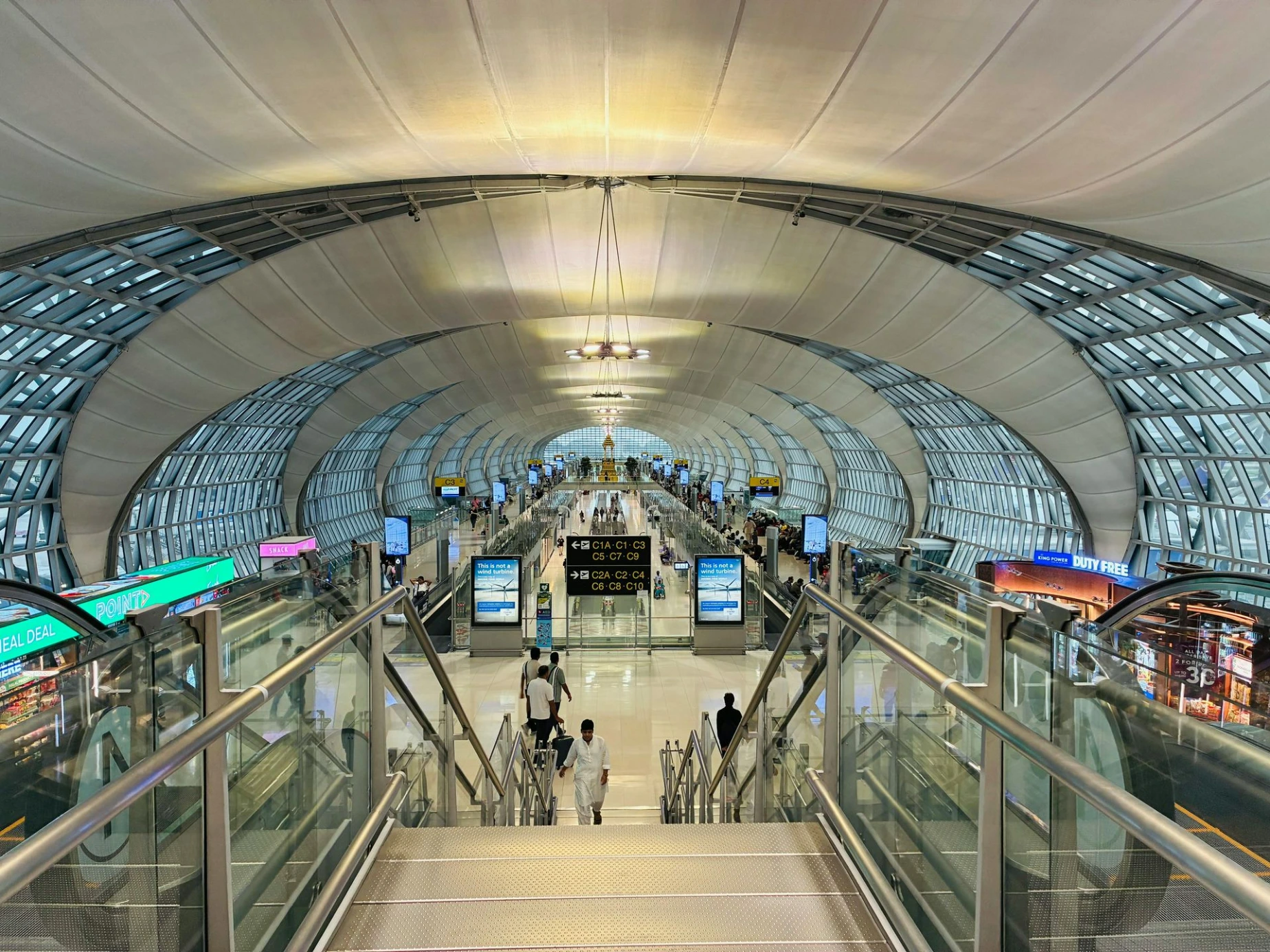
Suvarnabhumi Airport is the busiest airport in Thailand and the twentieth busiest in the world by passenger volume. It handled 62.2 million passengers in 2024, making it one of the most active aviation hubs in Southeast Asia.
The main terminal covers approximately 563,000 square meters and connects to the Bangkok city center via the Airport Rail Link, which reaches Phaya Thai station in about 30 minutes. This is the most efficient way into the city for most travelers and eliminates reliance on road traffic.
The SAT-1 Satellite Terminal: What Travelers Need to Know
SAT-1, the midfield satellite terminal, opened in September 2023 and added 28 contact gates, including 8 that can accommodate the Airbus A380. Passengers travel between the main terminal and SAT-1 via a driverless Automated People Mover in approximately 3.5 minutes through a one-kilometer underground tunnel.
One operational constraint matters for 2026 arrivals. At present, the baggage connection between SAT-1 and the main terminal is available only for outbound bags. Inbound bags from SAT-1 flights are currently transported by truck between buildings. AOT has submitted a 3.9-billion-baht inbound baggage handling system for cabinet approval. Until that system is in place, travelers arriving on flights using SAT-1 should allow additional time at baggage claim and not book onward transportation too tightly.
Expansion: What Is Being Built and When
Based on current AOT operational patterns, Suvarnabhumi Airport is handling approximately 60 million passengers annually, against a design limit of 65 million. An East Expansion targeting a total capacity of 80 million is underway. A South Terminal targeting a further 55 million passengers, plus a fourth runway, forms the longer-term phase. According to the Civil Aviation Authority of Thailand, these phased expansions are subject to regulatory and environmental review before construction timelines are confirmed. AOT has announced the addition of 80 automated immigration gates this year to reduce peak-period processing times.
Practical impact for 2026 travelers: Suvarnabhumi Airport is fully functional and well-connected, but operates under capacity pressure during the December to February peak months. Immigration queues can be significant. Premium lane options are available to eligible passport holders. Pre-arranged private hotel transfers eliminate uncertainty about the road on arrival.
Trade-off: Suvarnabhumi Airport is Thailand's most capable entry point and the most congested. For travelers whose first destination is the Andaman coast, it adds an unnecessary transit step if a direct route to Phuket International Airport or Krabi International Airport is available from their departure city.
Where this fits in your trip: Long-haul international arrival → Bangkok (2 to 3 nights) → Airport Rail Link to Phaya Thai → domestic flight to regional airport
Don Mueang International Airport (DMK): The Domestic and Budget Hub
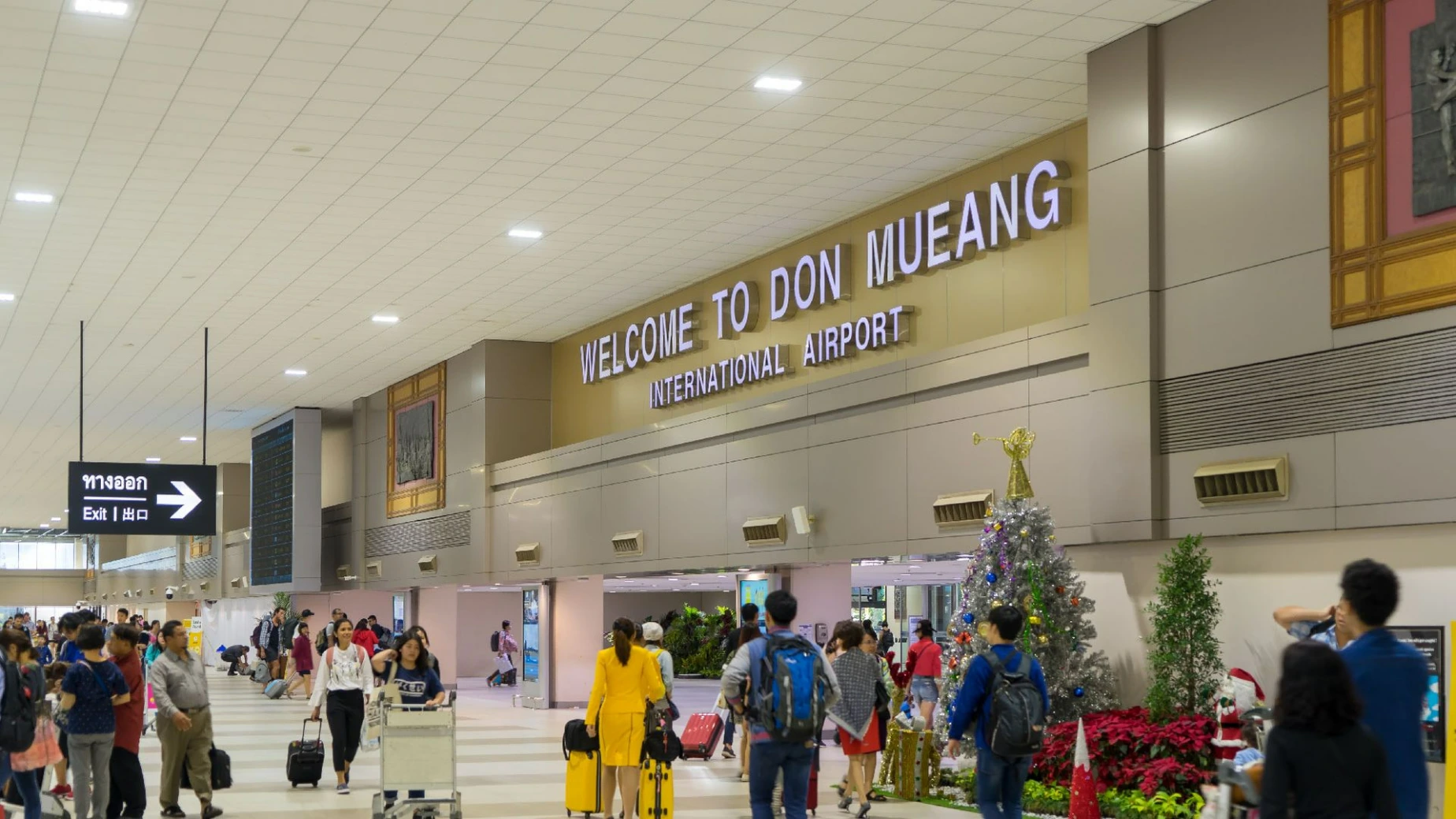
Don Mueang International Airport is Bangkok's second airport and the primary base for Thailand's low-cost domestic carriers: AirAsia, Nok Air, and Thai Lion Air. It also handles a significant volume of international budget routes to Asian regional cities, including Kuala Lumpur, Singapore, Guangzhou, and Kunming.
Don Mueang International Airport handled 31.3 million passengers in 2024, a 7.51 percent year-on-year increase. A Phase 3 expansion is in design review, targeting 40 to 50 million passengers annually, with a Junction Terminal designed to integrate with the Red Line commuter rail. Construction has not yet started as of early 2026.
This is where cheap flights save money and quietly steal a day.
The Bangkok Airport Transfer Problem
Most people do not realize this until it is too late.
Travelers arriving at Suvarnabhumi Airport on a long-haul international flight and connecting to a domestic carrier at Don Mueang International Airport are operating between two separate airports with no direct rail link between them. Road transfer, Bangkok traffic depending on the time of day, Don Mueang check-in, and security together make this a minimum of four to five hours.
This decision must be made before flights are booked. After that, your entire routing is locked, whether it makes sense or not.
The Red Line commuter rail now connects Don Mueang International Airport to Bang Sue Central Station, providing a rail option into central Bangkok. However, the proposed direct rail link between Don Mueang and Suvarnabhumi, part of the three-airport high-speed rail project, remains stalled. Travelers should not factor this connection into current itinerary planning.
The practical solution for luxury travelers: book the domestic departure from Don Mueang International Airport on the morning following international arrival at Suvarnabhumi. Use the Bangkok overnight as a planned night on the itinerary rather than a transit inconvenience.
Trade-off: Lower fares, significantly more logistical friction. No luxury lounge infrastructure comparable to Suvarnabhumi Airport. Don Mueang International Airport suits travelers who have pre-arranged ground transport, are arriving domestically within Thailand, or whose entire itinerary uses low-cost carriers from the outset.
Where this fits in your trip: Domestic connections only, or budget international arrivals from regional Asian hubs with pre-arranged private airport transfer
Phuket International Airport (HKT): The Andaman Coast Gateway
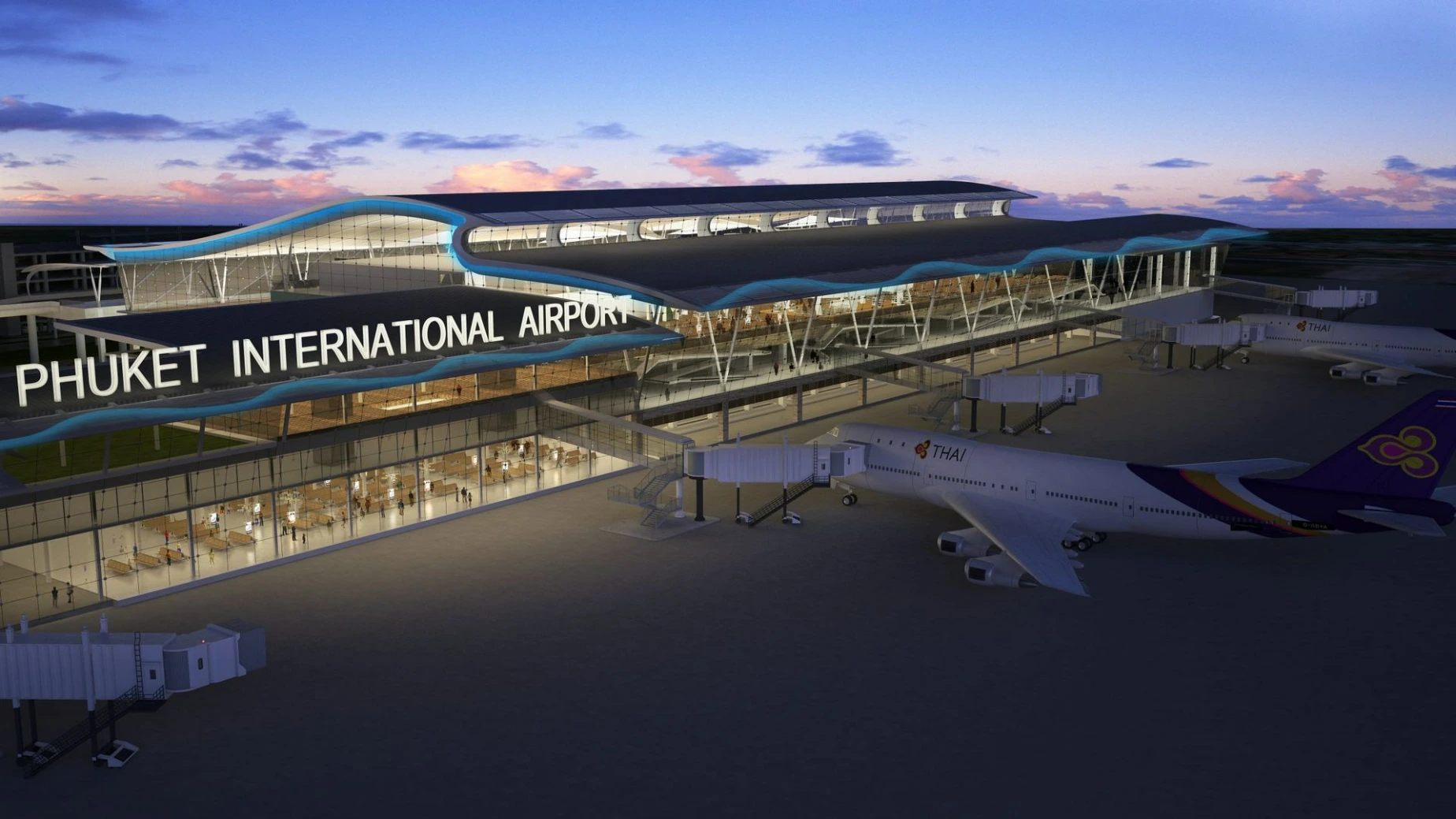
Phuket International Airport is the third busiest airport in Thailand and the primary entry point for international luxury travel to the Andaman coast. It handled 17.3 million passengers in 2024, with a 7.79 percent year-on-year increase in flight movements.
The case for flying directly into Phuket International Airport rather than transiting Bangkok is straightforward for most Andaman-focused itineraries. Direct long-haul connections operate from London Heathrow and Gatwick, Frankfurt, Paris, Dubai, Doha, Singapore, Kuala Lumpur, Hong Kong, Seoul, Tokyo, and multiple Chinese cities. Travelers from Europe, the Middle East, and Australia can arrive on the Andaman coast without touching Bangkok. For a seven-night itinerary, this saves one domestic flight, one airport transfer, and the better part of a day.
Phuket International Airport sits in northern Phuket, approximately 32 kilometers from Patong, 28 kilometers from Bang Tao and Surin Beach, and 45 kilometers from Chalong Pier. All access is by road. There is no rail link.
Peak-season traffic on the main road south from the airport, Route 402, can add 20 to 45 minutes to ground transfers in December and January. Pre-arranged private hotel transfers are the standard and reliable solution. Taxi queues at the terminal run long during peak arrival windows.
For the must-visit places in Phuket that require advance reservations, planning begins the moment the airport is confirmed. The best-positioned villas on the west coast and private boat charters in Phang Nga Bay are booked months in advance.
New Terminal Expansion: What Is Planned
A 6-billion-baht expansion project is in the design phase, with construction expected to begin after 2026 and completion targeted for 2029, increasing Phuket International Airport's capacity to 18 million passengers annually.
Beyond this, a second Andaman airport is under feasibility study in Phang Nga province. AOT has earmarked a 6,500-rai plot in Khok Kloi district at an estimated cost of around 75 billion baht, with construction targeted to start in 2027 and the airport expected to open in 2032. This is not relevant to 2026 travel planning but signals the region's long-term aviation trajectory.
For travelers connecting onward to Krabi, Koh Yao Noi, or Phi Phi after landing at Phuket International Airport, the Phuket to Krabi private transfer guide covers all boat, road, and private charter options in detail. For beach selection on the Andaman coast, the luxury beaches in Phuket and Krabi guide covers access structures and traveler fit by location.
Trade-off: Road-only access from Phuket International Airport means ground transfer times are entirely dependent on traffic. The lounge infrastructure is more limited than at Suvarnabhumi Airport. During December and January, the airport operates near capacity with corresponding queues at immigration and baggage reclaim.
Where this fits in your trip: International arrival (HKT) → Phuket west coast (Bang Tao or Surin, 30 to 40min by road) → Phang Nga Bay departure point (Bang Rong Pier, approximately 45min)
Krabi International Airport (KBV): Direct Andaman Access Without Phuket
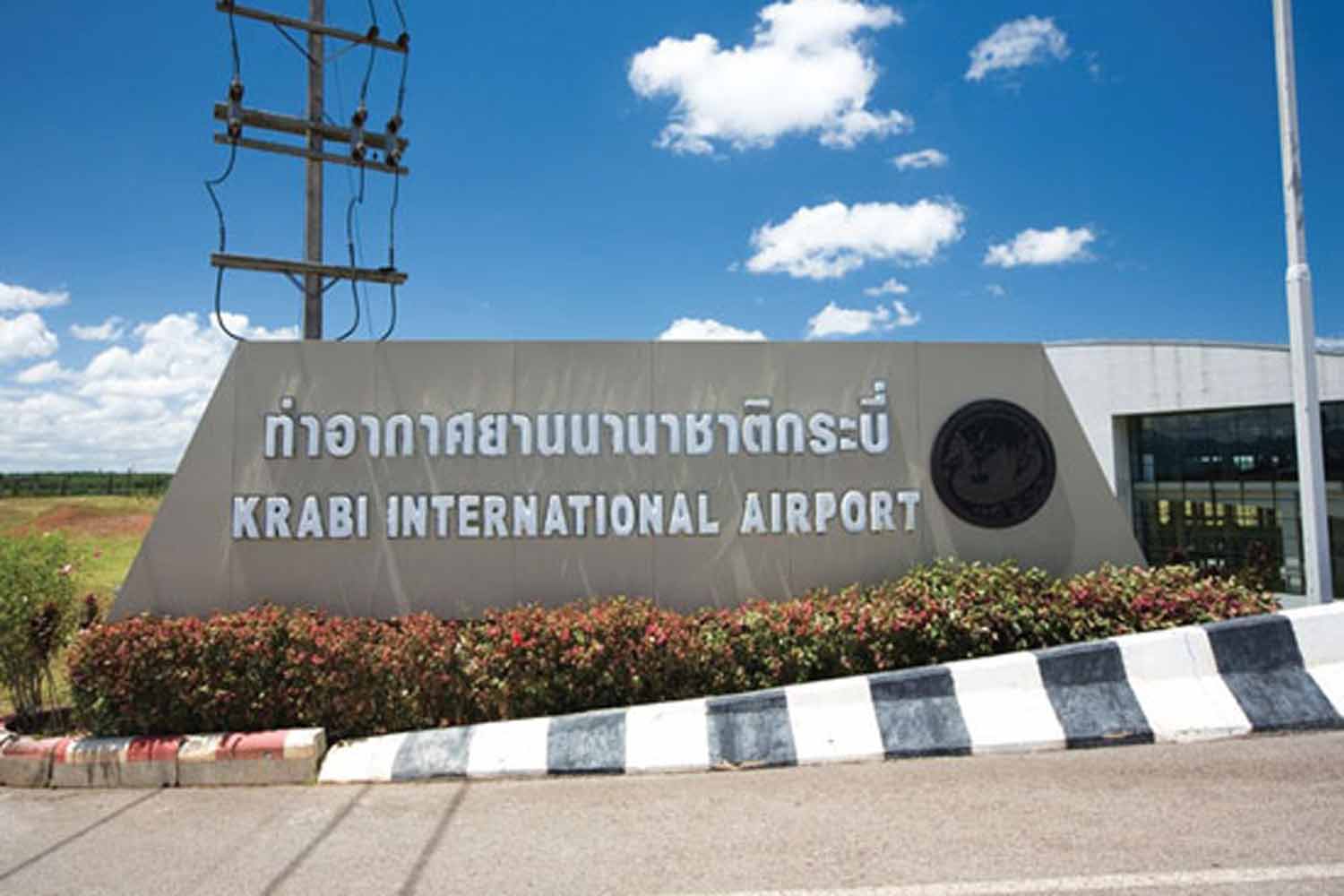
Krabi International Airport is the correct entry point for travelers whose first destination in the Andaman is Ao Nang, Railay Beach, Koh Lanta, or southern Krabi province. Flying into KBV rather than Phuket International Airport and then transferring saves the cost of a private speedboat or a road-and-ferry journey of 1 to 3 hours.
Krabi International Airport sits 15 kilometers from Krabi Town and approximately 25 kilometers from Ao Nang. Longtail boats to Railay Beach depart from Ao Nang pier, approximately 20 minutes from the airport by road.
A major expansion has recently been completed. AOT is pursuing a comprehensive expansion of Krabi International Airport to handle up to 12 million passengers annually, in line with the Southern Economic Corridor development plan. The expanded terminal has increased capacity and reduced the congestion that characterized peak-season operations at the previous facility.
International routes include Bangkok Airways, Thai Airways, AirAsia, and select seasonal European charter services. Fewer direct long-haul options are available than at Phuket International Airport, meaning some itineraries still require a Bangkok transit before reaching Krabi. The routing is worth checking explicitly: a direct flight from London to Krabi International Airport does not currently exist, but a direct flight from London to Phuket International Airport does, making HKT the correct entry airport for those travelers, even if Krabi is the first Andaman destination.
A Phuket arrival combined with a Krabi departure is a clean itinerary structure for travelers routing south through the Andaman. It eliminates backtracking and ends the trip at Krabi's quieter southern options before flying home.
For the luxury beaches in Phuket and Krabi comparison, which covers Railay, Ao Nang, and the surrounding beach access in detail, the Krabi airport question resolves naturally once the specific first beach destination is confirmed.
Trade-off: Fewer direct international routes than Phuket International Airport. Some travelers will still need a transit in Bangkok or Phuket to reach KBV, depending on their departure country. Lounge facilities remain basic compared with those at Suvarnabhumi Airport and Phuket International Airport.
Where this fits in your trip: International or domestic arrival (KBV) → Ao Nang (25min by road) → Railay Beach (20min by longtail from Ao Nang pier) → Koh Lanta (1.5 to 2hrs by road and ferry)
Chiang Mai International Airport (CNX): The Northern Gateway
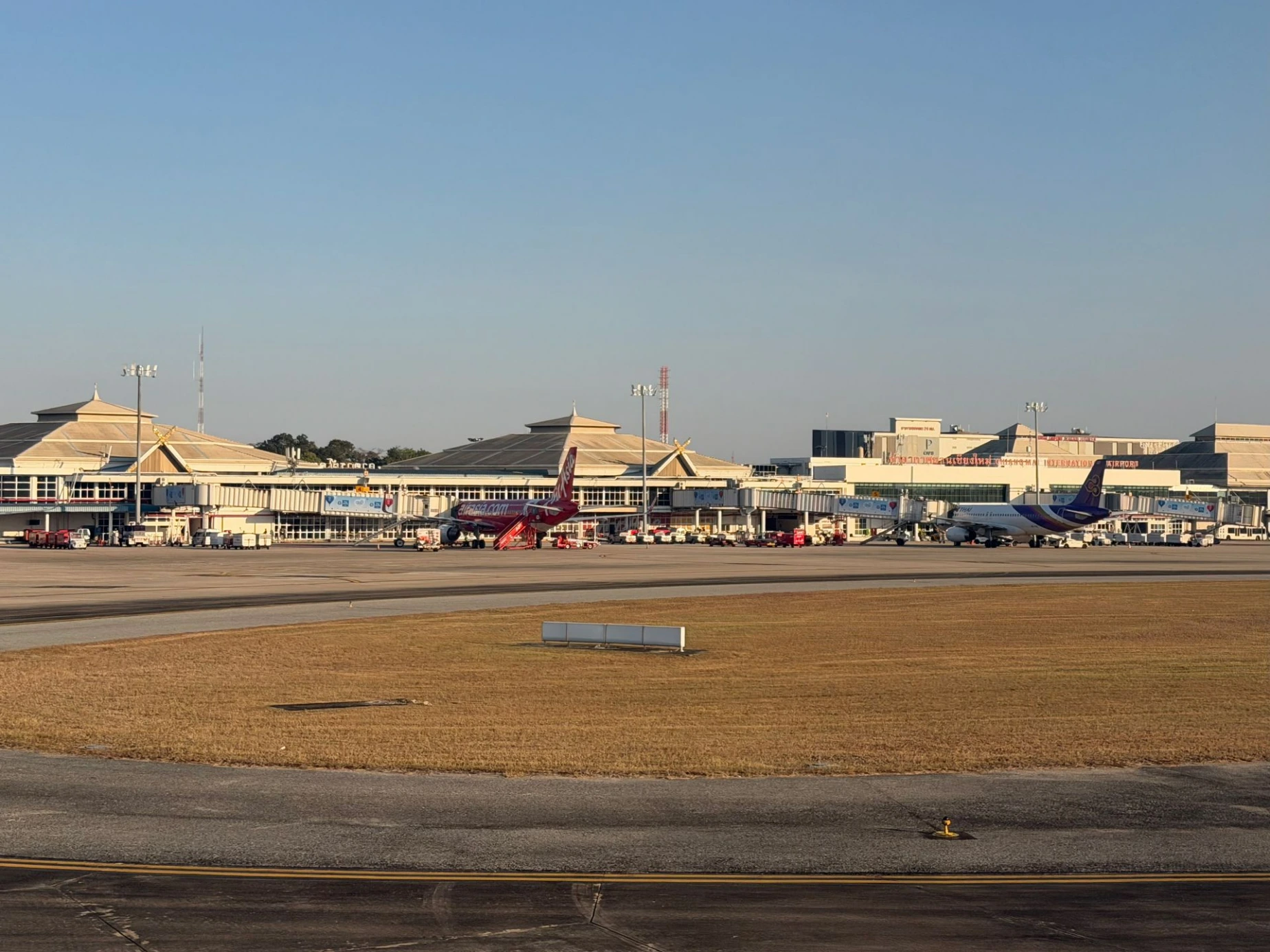
Chiang Mai International Airport is positioned 4 kilometers southwest of the Old City, making it the closest major airport to the city center in Thailand. Most hotels in the Old City and Nimmanahaeminda Road area are within 15 minutes by taxi.
Chiang Mai International Airport handled 9.38 million passengers in 2024, with a 10.11 percent increase in flight movements year-on-year.
International connections include direct routes from Singapore, Kuala Lumpur, Hong Kong, Seoul, and Tokyo. Chinese city connections are strong and growing. Travelers from regional Asian hubs can reach Northern Thailand without routing through Bangkok.
Direct service from Chiang Mai International Airport to Phuket International Airport exists but operates with limited frequency. Travelers combining Northern Thailand with the Andaman coast should plan a Bangkok connection, adding approximately half a day to the itinerary.
The burning season constraint applies from the moment of arrival. Between February and April, air quality in and around Chiang Mai deteriorates significantly. This does not affect flight operations at Chiang Mai International Airport, but it affects the experience from the moment the aircraft door opens. The city-center proximity advantage counts for less when outdoor walking itineraries are compromised by haze.
In practice, based on current airport operations, Chiang Mai International Airport functions best as a direct entry point for Northern Thailand stays from November through January, when air quality is clear and walking-heavy itineraries through the Old City and Doi Suthep are fully viable.
Expansion plans include a new passenger terminal, renovation of the existing facility, and road infrastructure upgrades. A feasibility study supports the development of a second Chiang Mai airport, referred to as Lanna Airport, in Ban Thi district, Lamphun province, at an estimated cost of around 72 billion baht, with a 2027 construction start targeted.
Trade-off: Limited direct long-haul routes. Most European, Australian, and North American travelers connect through Bangkok or a regional Asian hub to reach Chiang Mai International Airport. The terminal itself is small and can feel congested during the peak season in Northern Thailand, November to January.
Where this fits in your trip: Bangkok (BKK) domestic to CNX (1hr 20min) → Old City (15min by road) → optional Chiang Rai connection (3hr drive or short domestic hop)
Mid-Article CTA
If the Andaman coast is the primary destination and the choice between Phuket International Airport and Krabi International Airport is still open, the decision must be made before booking flights. After that, your entire routing is locked, whether it makes sense or not. Review the exact onward options in the Phuket to Krabi private transfer guide before confirming which airport to fly into. The two are not interchangeable for all itinerary structures.
Koh Samui Airport (USM): The Gulf Island Airport With Structural Constraints

Koh Samui Airport is unlike every other major airport in Thailand in one fundamental respect: it is privately owned and operated by Bangkok Airways. This single fact explains the pricing structure, the limited carrier options, and the fare premium that characterizes every flight to and from the island.
Koh Samui Airport is located in the Bo Phut subdistrict on the northern part of the island, approximately 2 kilometers from Chaweng, the main resort center. The airport is designed in an open-air tropical style with thatched roofs and natural materials, and is frequently cited as one of the most architecturally distinctive airports in Southeast Asia.
Because Bangkok Airways owns Koh Samui Airport and controls the majority of slot allocations, competing carriers have historically had limited access. Scoot launched a Singapore-to-Koh Samui Airport route using the Embraer E190 in May 2024, adding a meaningful alternative for regional travelers. Plans for direct routes to Dubai, Bali, and Kuala Lumpur have been discussed but are not confirmed at the time of writing.
Expansion: What Is Changing
Bangkok Airways plans to increase the permitted daily flights at Koh Samui Airport from 50 to 73. A 1.5-billion-baht expansion commitment forms part of a broader 2.2- to 2.3-billion-baht investment strategy covering Koh Samui Airport and Trat Airport over the next two to three years. Improvements include additional boarding gates, check-in counters, and expanded commercial areas.
Critically, this investment does not change the ownership structure or the resulting fare premium. The Bangkok Airways monopoly at Koh Samui Airport is structural, not operational. Renovation does not resolve it.
The Alternative Routing
Fly into Surat Thani Airport (URT) on a competing carrier, then take the ferry from Donsak Pier to Koh Samui. The crossing takes approximately 1.5 hours. This route opens up booking to competitive airfares and provides direct access to Koh Phangan (30 minutes onward by ferry from Koh Samui) and Koh Tao (a further 90 minutes by ferry). For travelers whose time is of specific value, the direct Koh Samui Airport route remains the right trade-off despite the premium. For those with flexibility, Surat Thani is the financially sound alternative.
Trade-off: Higher fares, limited carrier choice, smaller infrastructure. The ongoing expansion will increase capacity but will not address the underlying pricing structure at Koh Samui Airport.
Where this fits in your trip: Bangkok (BKK) → Koh Samui Airport (USM), 1hr 30min → Chaweng or Bo Phut resort area (5 to 15min by road)
The One Mistake That Breaks Thailand Itineraries
It is not choosing the wrong hotel.
It is not picking the wrong island.
It is booking flights before understanding how the airports connect.
The airport decision is the first load-bearing choice in any itinerary in Thailand. Everything downstream, from transfer times to first-night location to island access, is determined by which airport you land in and which one you depart from. Most travelers make this choice last. The ones who get it right make it first.
Connecting Between Airports: The Operational Reality
The Suvarnabhumi to Don Mueang Transfer in Full Detail
This is the transfer that most often damages itineraries when not planned correctly.
Suvarnabhumi Airport and Don Mueang International Airport are approximately 25 kilometers apart by road. In normal conditions, the taxi journey takes 45 minutes to 1 hour. During Bangkok's peak traffic hours, roughly 7 am to 9 am and 5 pm to 8 pm, the same journey regularly takes more than 90 minutes. Add baggage collection at Suvarnabhumi, the road journey, check-in at Don Mueang International Airport, security, and the minimum realistic buffer is four to five hours.
Booking this tighter is a gamble that regularly fails. The consequence is a missed domestic flight and, in peak season, a replacement departure that may not be available until the following day.
The Red Line commuter rail provides an alternative for travelers arriving at Don Mueang International Airport and needing to reach central Bangkok. The line runs from Don Mueang to Bang Sue Central Station, connecting to the MRT and other city rail lines. It is viable for those without large luggage and who are comfortable with the interchange.
Using Regional Airport Pairs in Your Itinerary
These are the cleanest multi-airport routing structures for luxury travelers.
Fly into Phuket International Airport (HKT), depart from Krabi International Airport (KBV). Works for a south-to-north Andaman routing covering Phuket, Phang Nga Bay, and Krabi without backtracking. The Phuket to Krabi private transfer handles the mid-itinerary transfer via a private speedboat.
Fly into Suvarnabhumi Airport (BKK), depart from Phuket International Airport (HKT). The most common structure for a Central-and-Andaman two-region trip.
Fly into Suvarnabhumi Airport (BKK) or Chiang Mai International Airport (CNX), depart from Phuket International Airport (HKT). Works for a three-region North-to-Andaman structure. Requires a Bangkok connection between CNX and HKT in most cases.
Fly into Suvarnabhumi Airport (BKK), depart from Koh Samui Airport (USM). Works for a Central plus Gulf Coast structure, accepting the Bangkok Airways departure fare as the exit cost.
For travelers adding the Phi Phi Islands to the Andaman segment after landing at Phuket International Airport, the Bangkok-to-Phi Phi Islands private transfer guide covers the full routing from both Bangkok and Phuket, including departure piers and journey times.
When Bypassing Bangkok Is the Right Decision
Suvarnabhumi Airport is the default entry point for most travelers, but it is not always the correct one. Three traveler profiles consistently benefit from bypassing it.
Travelers with 7 nights or fewer on the Andaman coast. A direct flight to Phuket International Airport or Krabi International Airport eliminates the Bangkok transit day and allows the traveler to be on the Andaman coast for the first night. This is the highest-return routing for short Andaman itineraries.
Travelers connecting from Singapore, Kuala Lumpur, or Hong Kong with a Gulf Coast final destination. Bangkok Airways operates direct flights to Koh Samui Airport from these hubs. Routing through Bangkok adds a domestic connection and a terminal change that the direct option avoids.
Travelers visiting only Northern Thailand from regional Asian hubs. Direct connections from Chiang Mai International Airport to Singapore, Seoul, Tokyo, Kuala Lumpur, and Hong Kong allow a Bangkok bypass for those with a Northern-only itinerary.
Who This Guide Is Not For
Airport selection as a planning decision primarily applies to travelers with multi-stop or multi-region itineraries, where the entry point significantly affects routing and timing.
It is less relevant to travelers arriving by private jet or helicopter, where FBO handling and private terminal access entirely replace commercial airport logistics. It is also less relevant for single-resort stays where the property manages all transfers and arrival logistics, and for travelers entering Thailand overland from a land border crossing.
For those building luxury Andaman or Gulf Coast itineraries from scratch, the airport choice and the first-night location are the two decisions that shape everything that follows. Getting both right before booking anything else is what this Thailand Airports Guide is designed to help you do.
For destination-level planning across the full range of luxury experiences, once airports are confirmed, the luxury Thailand travel experiences guide covers options in all regions in detail.
Airport Entry Points: Itinerary Routing by First Destination
| Suvarnabhumi Airport (BKK)Airport, First Destination, Onward Transfer, Best | Bangkok (2 nights) | Domestic to HKT or CNX | Phuket International Airport (HKT) or Chiang Mai International Airport (CNX) |
| Phuket International Airport (HKT) | Phuket west coast or Phang Nga Bay | Private speedboat to Koh Yao Noi or Krabi | Krabi International Airport (KBV) or back to HKT |
| Krabi International Airport (KBV) | Ao Nang or Railay Beach | Road or speedboat to Koh Lanta | KBV or Phuket International Airport (HKT) |
| Chiang Mai International Airport (CNX) | Old City or Doi Suthep | Domestic via BKK to HKT | Phuket International Airport (HKT) |
| Koh Samui Airport (USM) | Koh Samui or Bo Phut | Ferry to Koh Phangan or Koh Tao | USM or Surat Thani (URT) via ferry |
Airport selection and the first onward transfer are the two planning decisions that shape everything that follows on an Andaman or Northern Thailand itinerary. For travelers connecting south to Phi Phi or Phang Nga Bay after landing at Phuket International Airport, the Bangkok to Phi Phi Islands private transfer guide and the Phuket to Krabi private transfer guide cover the exact departure points, boat options, and timing windows before any charter is confirmed.
FAQ: Thailand Airports Guide
What are the main airports in Thailand for international travelers?
The main airports in Thailand for international travelers are:
- Suvarnabhumi Airport (BKK): Bangkok, primary long-haul international hub
- Don Mueang International Airport (DMK): Bangkok, budget and domestic connections
- Phuket International Airport (HKT): Direct Andaman coast access
- Chiang Mai International Airport (CNX): Northern Thailand, regional Asian connections
- Krabi International Airport (KBV): Andaman coast, direct Railay and Ao Nang access
- Koh Samui Airport (USM): Gulf Coast island access
Most long-haul travelers from Europe, North America, and Australia arrive at Suvarnabhumi Airport. Travelers from regional Asian hubs often have direct access to Phuket International Airport, Chiang Mai International Airport, or Koh Samui Airport without routing through Bangkok.
What is the difference between Suvarnabhumi Airport and Don Mueang International Airport in Bangkok?
Suvarnabhumi Airport (BKK) is Bangkok's primary international airport, serving long-haul carriers and connected to the city by the Airport Rail Link. Don Mueang International Airport (DMK) is the budget and domestic hub, handling AirAsia, Nok Air, and Thai Lion Air. The two airports are approximately 25 kilometers apart with no direct rail link between them. Travelers connecting between them should allow at least 4 to 5 hours. Booking a tight same-day connection between an international arrival at Suvarnabhumi and a domestic departure from Don Mueang is the most common cause of missed connections in Thailand.
Should I fly into Phuket International Airport or Krabi International Airport for the Andaman coast?
Fly into Phuket International Airport (HKT) if your first destination is Phuket's west coast, Phang Nga Bay, or Koh Yao Noi. Fly into Krabi International Airport (KBV) if your first destination is Ao Nang, Railay Beach, or Koh Lanta. Phuket has more direct international connections and is the correct entry point for most long-haul travelers. Krabi eliminates the Phuket-to-Krabi transfer for those traveling directly to Krabi. A Phuket arrival with a Krabi departure also makes for a clean itinerary when routing south along the Andaman coast.
Can I arrive at one Thai airport and depart from another?
Yes, and for many Andaman itineraries, it is the operationally superior structure. The most effective multi-airport combinations are: fly into Phuket International Airport (HKT) and depart from Krabi International Airport (KBV) for a south-to-north Andaman routing; fly into Suvarnabhumi Airport (BKK) and depart from Phuket International Airport (HKT) for a Bangkok-plus-Andaman structure; fly into Chiang Mai International Airport (CNX) and depart from Phuket International Airport (HKT) for a three-region culture-to-coast itinerary. Open-jaw ticketing for these combinations is available on most major booking platforms.
Why are flights to Koh Samui Airport more expensive than flights to other Thai airports?
Koh Samui Airport (USM) is privately owned and operated by Bangkok Airways. Because Bangkok Airways controls the majority of slot allocations and operates most scheduled services, it sets fare structures without the competitive pressure that applies at AOT-operated airports. This structural monopoly results in consistently higher fares than on comparable domestic routes. The alternative is to fly into Surat Thani Airport (URT) with a competing carrier and take the ferry to Koh Samui, which adds about 2 hours but significantly reduces the airfare.
How much time should I allow to transfer between Bangkok's two airports?
Allow a minimum of four to five hours between an international arrival at Suvarnabhumi Airport (BKK) and a domestic departure at Don Mueang International Airport (DMK). This covers baggage collection, taxi transfer, check-in, and security at Don Mueang. During peak Bangkok traffic hours, the road transfer alone can take more than 90 minutes. The safest approach is to book the domestic departure from Don Mueang International Airport for the morning after international arrival at Suvarnabhumi, and to plan an overnight in Bangkok as part of the itinerary.
Is the Thailand Airports Guide relevant if I am only visiting one destination?
For single-destination trips where the hotel manages all transfers and the airport is determined by the destination, this guide adds limited planning value. It is most relevant for travelers building multi-stop or multi-region itineraries, where the entry airport has significant consequences for routing, time allocation, and the first-night location. For those travelers, airport selection is the first structural decision that shapes every subsequent booking.
Conclusion
Thailand's airports are not interchangeable. Suvarnabhumi Airport, Don Mueang International Airport, Phuket International Airport, Chiang Mai International Airport, Krabi International Airport, and Koh Samui Airport each serve a distinct purpose and connect to a distinct set of onward destinations. The decision about which airport to use is not a detail to be resolved after flights are booked. It is the first structural decision that determines how efficiently the rest of the itinerary moves.
For most luxury travelers, the Andaman coast itinerary begins correctly at Phuket International Airport or Krabi International Airport, not Bangkok. The Northern itinerary begins correctly at Chiang Mai International Airport for those with direct regional connections. The Gulf Coast itinerary routes through either Koh Samui Airport or Surat Thani, depending on fare tolerance and available time.
Bangkok remains the unavoidable hub for long-haul arrivals, with no direct regional alternatives. Used as a two-night cultural starting point with a pre-planned domestic connection, it works efficiently. Used as an unplanned transit with a tight same-day connection to Don Mueang International Airport, it does not.
In Thailand, the wrong airport costs you time. The right one buys you the trip you thought you booked, without friction, without wasted days, without compromise.
In Thailand, the journey does not begin when you land. It begins with the one decision that quietly shapes everything that follows.