
This is usually approached as a product comparison. They research plans, compare providers, and try to identify the cheapest data package. That is the wrong starting point.
The real decision is about setup friction, not price. Thailand's mobile data is among the most affordable in Southeast Asia. The cost difference between a local SIM and an eSIM rarely exceeds 300-500 baht for a two-week trip. What actually affects your arrival experience is whether connectivity works before you leave the airport, and how much effort it takes to make that happen.
The question worth answering before you land: do you want staff-assisted setup at the counter, or a digital activation you handle yourself before departure?
The Direct Answer
A local Thailand SIM card is the right choice for most travelers. It offers the best cost-per-gigabyte, passport-registered setup handled on-site, and easy replacement or top-up at any major convenience store or carrier shop. A Thailand eSIM is the better option for short stays of three to seven days, multi-destination itineraries, or travelers who want to keep their primary number active throughout the trip. International roaming is rarely justified on cost or performance grounds.
Quick Decision Reference
| Travel Situation | Best Option |
|---|---|
| 1 to 2 weeks, single destination | Local SIM |
| 3 to 7 days, short trip | eSIM |
| Multi-country itinerary | eSIM |
| Remote work or heavy data usage | Local SIM (large plan) |
| Business travel needs a primary active number | eSIM |
| First time in Thailand, want a guided setup | Local SIM |
SIM vs eSIM vs Roaming: What Each Option Actually Means
Local Thailand SIM card. A physical prepaid SIM purchased at the airport or a carrier store. Have staff register it against your passport (a legal requirement under Thai telecom law), install it on your phone, and confirm the network is live before you walk away. Plans typically range from 10 GB short-stay options to 50 GB or unlimited packages for extended trips.
Thailand eSIM. A digital SIM delivered as a QR code, purchased online before departure. Activation happens through your phone's settings menu. No physical swap is required, and your original SIM stays in place. The setup must be completed before or immediately after landing. If the configuration goes wrong, there is no counter staff to help you fix it.
International roaming. Uses your home network with no setup required. It is operationally effortless, but costs are typically three to five times higher than local options, and many roaming plans cap speeds once a daily data threshold is reached.
For most trips, both options work. The difference is how much effort you want to put into handling before or after landing.
Where to Buy a Thailand SIM Card
Airports are the default option for most travelers, and the small price premium over city stores is not worth the hassle of avoiding them. Thailand is one of the few countries where buying a SIM on arrival is faster than setting one up yourself. Counters at Bangkok Suvarnabhumi (BKK), Don Mueang (DMK), Phuket International (HKT), and Chiang Mai International (CNX) are positioned immediately after immigration, before the baggage claim exit. You do not need to leave the arrivals hall and return.
The setup process at airport counters is straightforward. Staff scans your passport to complete the SIM registration required by the National Broadcasting and Telecommunications Commission (NBTC). They install the SIM, select your plan, and test the network signal before handing your phone back. The process takes three to five minutes under normal conditions. During peak arrival windows at Suvarnabhumi, particularly on Saturday mornings and late-night international arrivals, wait times can extend to 15 to 20 minutes.
City stores and mall counters are useful for replacing a SIM, switching to a longer plan, or extending data mid-trip. AIS, DTAC, and TrueMove all operate branded retail locations in Central shopping malls across Bangkok, Phuket, Chiang Mai, and Krabi. Staff at city locations often speak more English than convenience store staff.
Convenience stores (7-Eleven, Family Mart) stock basic SIM kits, but plan selection is limited, and staff assistance is inconsistent. These are best used for top-ups rather than initial activation.
For airport transfer decisions that intersect with your arrival logistics, the Thailand airport transfer options guide explains how SIM setup fits into the broader arrival sequence at each major airport.
Buying a Thailand eSIM Before You Depart
Thailand eSIM plans are available through several international digital providers. Purchases happen online, the QR code arrives via email, and activation is completed via phone settings. The critical requirement is that your device must be unlocked and eSIM-compatible. Most iPhones from the XS onward and most flagship Android devices from 2020 onward support eSIM, but mid-range and budget Android handsets vary.
A 15 GB eSIM package might cost 600 to 900 baht, whereas a comparable physical SIM runs 350 to 550 baht. The premium is the price of zero setup friction on arrival.
The limitation that most eSIM comparisons overlook is that if activation fails or the data does not connect properly, resolution requires either troubleshooting through the provider's online support or purchasing a local SIM anyway. At that point, you have paid for both.
Thailand Mobile Networks: AIS, DTAC, and TrueMove
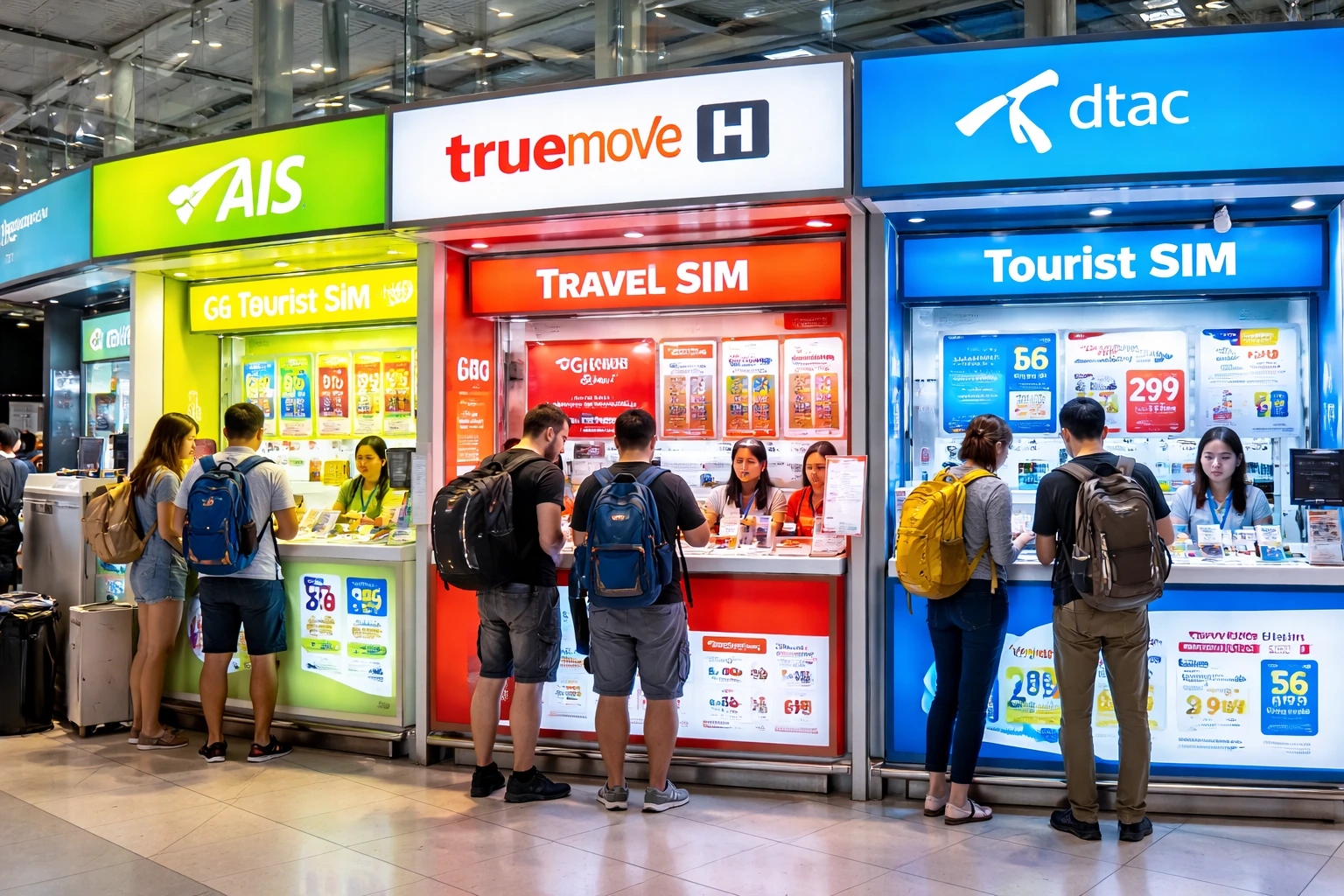
Three networks cover Thailand's tourist infrastructure. AIS is the most consistent performer across cities, islands, and rural areas, making it the default recommendation for most travelers. DTAC offers competitive pricing and performs well in urban areas but shows a weaker signal in remote locations. TrueMove offers strong citywide coverage and aggressive pricing on its tourist plan, particularly for short stays.
The operationally important point is that network differences matter less than location. In Bangkok, Phuket, Chiang Mai, Krabi, and Koh Samui, all three networks deliver reliable 4G service. Coverage drops predictably in specific situations: during speedboat transfers between islands, in forested interior regions, and away from main roads in northern provinces. This pattern applies regardless of provider.
A traveler visiting Khao Sok National Park should expect reduced signal in the jungle interiors. The Khao Sok planning guide covers this, along with logistics for the lake stay, where connectivity is limited by geography rather than by carrier choice.
Cost Reality: What You Actually Pay
Thailand consistently ranks among the lowest-cost mobile data markets in Southeast Asia. The cost differences between plans and between SIM and eSIM are rarely significant relative to overall trip costs.
Typical tourist SIM plan pricing (2026 estimates):
| Plan Size | Typical Cost (THB) | Best For |
|---|---|---|
| 10 to 15 GB | 300 to 450 | 5 to 7-day trip |
| 20 to 30 GB | 450 to 650 | 10- to 14-day trip |
| 50 GB | 700 to 950 | Extended stay or heavy usage |
| Unlimited (speed capped after threshold) | 650 to 900 | Digital nomads, remote work |
eSIM pricing for the same data volumes ranges from approximately 600 to 1,400 baht, depending on the provider and plan duration.
International roaming from major home carriers typically costs 1,500 to 4,000 baht or more for two weeks of equivalent data, often with speed restrictions once a daily threshold is reached.
The cost gap between local SIM and eSIM is real but modest. The gap between local options and roaming is significant and difficult to justify unless your provider offers a specific flat-rate international plan.
Friction vs Cost: The Only Decision That Matters
The SIM versus eSIM comparison ultimately comes down to which trade-off fits your travel pattern.
eSIM advantages: No SIM swap required on arrival. Your primary number stays active. Connectivity can be live before you land. Suitable for multi-destination travel where swapping SIMs at each border is impractical.
eSIM limitations: Higher cost. Device compatibility must be confirmed before purchase. Self-service troubleshooting if activation fails. No local support structure.
Local SIM advantages: Best value per gigabyte. Staff-assisted setup. Easy top-up and replacement anywhere in Thailand. Plans scale easily for longer trips.
Local SIM limitations: Requires a physical SIM swap. The primary number is inactive while the Thai SIM is in use. Minor inconvenience if you rely on two-factor authentication tied to your home number.
For most one- to two-week Thailand itineraries, a local SIM is the more practical choice. The setup takes five minutes, and the cost savings are real. For travelers managing a multi-country Southeast Asia route or combining a trip to Thailand with other destinations, an eSIM eliminates the logistical overhead of swapping cards at each border.
How Much Data Do You Actually Need in Thailand
Daily data usage varies significantly by travel style. Light usage (maps, messaging, occasional browsing) consumes approximately 0.5-1 GB per day. Moderate usage (social media, video calls, streaming occasional content) runs 1.5 to 2.5 GB per day. Heavy usage (remote work, video streaming, hotspot sharing) runs 3 GB or more per day.
Practical estimates by trip length:
| Trip Duration | Recommended Plan Size |
|---|---|
| 5 to 7 days | 10 to 15 GB |
| 10 to 14 days | 20 to 30 GB |
| 3 to 4 weeks | 50 GB or unlimited |
| Remote work trip | Unlimited (confirm speed cap threshold) |
One variable most travelers underestimate: hotspot usage. If you use your phone as a mobile hotspot for a laptop, daily usage can quickly double or triple. Size up your plan if a hotspot is part of your workflow.
For a detailed breakdown of usage patterns and how to estimate your exact needs, see how much data you actually need in Thailand.
For broader trip planning that affects how you move between regions and how connectivity fits each leg, the Thailand 2-week itinerary guide maps out the routing logic and what to expect at each stop.
Setup Process: What Actually Happens
Airport SIM counter process: Your passport is required and scanned. This is a legal registration requirement under Thai telecom law, not optional. Select the plan you chose, insert the SIM, and confirm the signal before you leave the counter. If the signal is weak at the counter position (which occasionally happens near structural interference), staff will walk you to an open area to retest. You leave with a working Thai mobile number and data connection.
eSIM setup process: After purchasing online, you receive a QR code by email. In your phone settings, navigate to Mobile Data, then Add eSIM, and scan the QR code. The data plan activates after the eSIM profile is installed, typically within 60 seconds on a stable connection. This must be completed while connected to WiFi if you have not yet arrived. Attempting to activate in transit without WiFi will fail. The settings to enable the eSIM as your data line (while keeping your primary SIM for calls) must be configured correctly to avoid roaming charges on your home SIM.
Coverage Reality in Thailand
Strong 4G coverage: Bangkok (all districts), Phuket (main roads and beaches), Chiang Mai (city and surrounding towns), Krabi Town and Ao Nang, Koh Samui (main coastal road), Koh Lanta (main areas), Pattaya, Hua Hin. In major cities, 4G speeds typically range between 20 and 80 Mbps, depending on network load and time of day.
Variable coverage zones:
- Remote islands: Koh Tao and Koh Phangan have reasonable coverage at the pier and main beaches, but drop in interior areas
- National parks: Khao Sok and Doi Inthanon show significantly reduced signal in forest interiors
- Northern mountains: Coverage follows roads; off-road trekking areas are largely unconnected
- Boat transfers: Signal is inconsistent during open-water crossings regardless of provider, including the Surat Thani to Koh Samui ferry route
Island-hopping itineraries should account for connectivity gaps during transfers and at smaller islands. This is particularly relevant if you are managing a multi-island route. The Thailand islands guide covers the connectivity profiles of major islands, along with access logistics.
Common Mistakes to Avoid
Buying an unlimited plan without checking the speed cap. Most Thai unlimited SIM plans throttle speeds to 1 Mbps once a daily threshold of 1 to 2 GB is reached. That is sufficient for messaging and maps, but not for video calls or streaming. If speed is a concern, confirm the threshold before purchasing.
Choosing an eSIM without verifying device compatibility. Locked devices from certain carriers and budget Android handsets frequently lack eSIM support. Check your device specifications before purchasing an eSIM plan, not after.
Underestimating data usage on island trips. Island resorts often have weak or expensive WiFi. Mobile data becomes the primary connection. Size your plan up if you are spending significant time at beach destinations.
Relying on airport WiFi during arrival. Bangkok Suvarnabhumi has public WiFi, but it is congested during peak arrival hours. eSIM activation on airport WiFi can fail if the connection drops mid-process. If activating an eSIM, do so before departure from home.
Assuming roaming rates have improved. Some international carriers now offer daily flat-rate roaming. Before assuming roaming is automatically expensive, check your specific carrier's current rate in Thailand. For most travelers, a local SIM or eSIM still outperforms roaming on both cost and speed.
Who Each Option Is Not For
eSIM is not the right choice if:
- You want the lowest possible cost per gigabyte
- Your device compatibility is unconfirmed
- You want in-person support if something goes wrong
- You are arriving with heavy luggage and prefer a handled setup process
Local SIM is not the right choice if:
- You need your primary number to be continuously active for business or two-factor authentication
- You are visiting Thailand as part of a four- or five-country trip and want a single connectivity solution
- You have a short stay of three days or fewer, and the setup time is not worth the savings
Roaming is not the right choice if:
- You have more than a few days in Thailand
- You expect to use more than 2 GB of data
- Cost is any consideration at all for the trip
Recommendations by Trip Type
| Trip Type | Recommended Option | Plan Size |
|---|---|---|
| First-time visitor, 1 to 2 weeks | Local SIM (AIS or TrueMove) | 20 to 30 GB |
| Short trip, 5 to 7 days | eSIM or local SIM | 10 to 15 GB |
| Multi-country Southeast Asia | eSIM (regional or Thailand-specific) | 15 to 20 GB |
| Remote work, extended stay | Local SIM (unlimited plan) | Unlimited |
| Business travel | eSIM | 10 to 15 GB |
| Island-heavy itinerary | Local SIM | 30 GB (size up for hotspot) |
Thailand travel logistics extend beyond connectivity. For a practical overview of what to prepare before arrival, including currency, visa categories, and transport decisions, the Thailand travel tips guide covers the full pre-trip decision set.
FAQs
Is an eSIM better than a SIM card in Thailand? Not for most travelers. eSIM is more convenient, particularly for arrivals who want immediate connectivity without any setup. Local SIMs offer better value and staff-assisted configuration at the airport. Choose eSIM for convenience. Choose a local SIM for cost and operational simplicity.
Can I buy a SIM card at the Bangkok airport? Yes. AIS, DTAC, and TrueMove all operate official counters at Suvarnabhumi and Don Mueang. Counters are located immediately after immigration. Passport registration is required. Setup takes three to five minutes under normal wait conditions.
Which network is best in Thailand? AIS is generally the most consistent performer across cities, islands, and rural areas. DTAC and TrueMove are competitive in urban zones. In tourist areas, practical differences between networks are minimal.
How much does a SIM card in Thailand cost in 2026? Tourist SIM plans range from approximately 300 to 450 baht for 10 to 15 GB, up to 700 to 950 baht for 50 GB. Unlimited plans (with speed caps) run from 650 to 900 baht. Airport counter pricing is slightly higher than city store pricing.
Do I need to unlock my phone before buying a Thai SIM? Yes. A locked phone will not accept a foreign SIM card. Check with your home carrier before departure. Most carriers unlock phones for free once a contract period is complete, though processing can take 24 to 72 hours.
Is 5G worth considering for travel in Thailand? No. 4G LTE delivers sufficient speed for navigation, streaming, and video calls. 5G availability is limited to central urban areas and does not meaningfully improve most travel use cases. For SIM selection, 5G support is not a relevant factor.
What happens if I run out of data mid-trip? Local SIM top-ups are available at any 7-Eleven, Family Mart, or carrier store. Top-ups can also be processed via the AIS, DTAC, or TrueMove apps using a credit card. eSIM top-ups depend on your provider's app or website and may have fewer options for mid-trip data additions.
Conclusion
Thailand is operationally straightforward for mobile connectivity. The infrastructure is reliable, the pricing is low, and the setup process at any major airport is designed for travelers arriving without any prior preparation.
The decision comes down to when you want to handle connectivity: before departure or upon arrival.
Choose a local SIM if value and on-the-ground support matter. Choose an eSIM if seamless arrival and multi-destination flexibility are the priority. Either option works. Roaming, in most cases, does not.
Connectivity is a logistics decision, not a research project. Resolve it before departure, so your first hours in Thailand are spent moving, not troubleshooting.