
Thailand travel guides tend to open with a list. Step one, step two, step three. What they skip is the part that actually costs people time: not knowing which decisions matter before the airport, which ones happen inside it, and which ones can wait until you are out the other side.
This guide separates those three stages, so you know what to do before you land, what matters at the airport, and what can wait until you are in the city. Whether you are landing at Suvarnabhumi or Don Mueang, arriving at noon or 02:00, traveling alone with a carry-on or with a family and four checked bags, the choices you face are different. What follows gives you the information to make them well.
Quick Take
Before you land
- Submit your TDAC at tdac.immigration.go.th within 72 hours of arrival. Free. Any site charging a fee is not the official portal.
- Save the QR code as a screenshot and a PDF. Do not rely on airport Wi-Fi to load your email.
At the airport
- Carry evidence of at least THB 10,000 per person (THB 20,000 per family). Immigration can ask.
- AIS tourist SIM: 499 THB for 8 days unlimited. Best default choice if you are unsure which network to pick. Available 24 hours at the arrivals counters.
Getting into the city
- Airport Rail Link: 45 THB to Phaya Thai, 26 minutes. Runs 05:30 to midnight.
- Metered taxi to Sukhumvit or Silom: 350 to 500 THB, including the 50 THB airport surcharge and tolls.
- Worst mistake: accepting a flat-fare offer from a driver outside the official taxi queue. Flat offers run 500 to 800 THB for a ride that costs 350 to 500 THB on the meter.
Which Airport Are You Landing At?
Bangkok is served by two international airports. Knowing which one you are using affects your immigration queue, transport options, and timing.
Suvarnabhumi (BKK): Full-service international hub. Direct Airport Rail Link to the city center. 24-hour SIM counters. Automated Border Control gates will be available for eligible passports as of early 2026.
Don Mueang (DMK): Budget carrier hub serving AirAsia, Nok Air, and Thai Lion Air. Red Line train into the city. Smaller immigration hall with documented queue times of 45 minutes to two hours during the late-night budget flight window.
If you are landing in Phuket, Chiang Mai, or Koh Samui, the TDAC and SIM card processes covered in this guide are identical. Transport options at those airports differ significantly depending on your destination. For help deciding where you are actually going, the best places to visit across Thailand guide covers the full picture.
If you have a choice, your arrival experience is generally smoother at Suvarnabhumi than at Don Mueang.
The TDAC: The One Step That Changed Everything in 2025
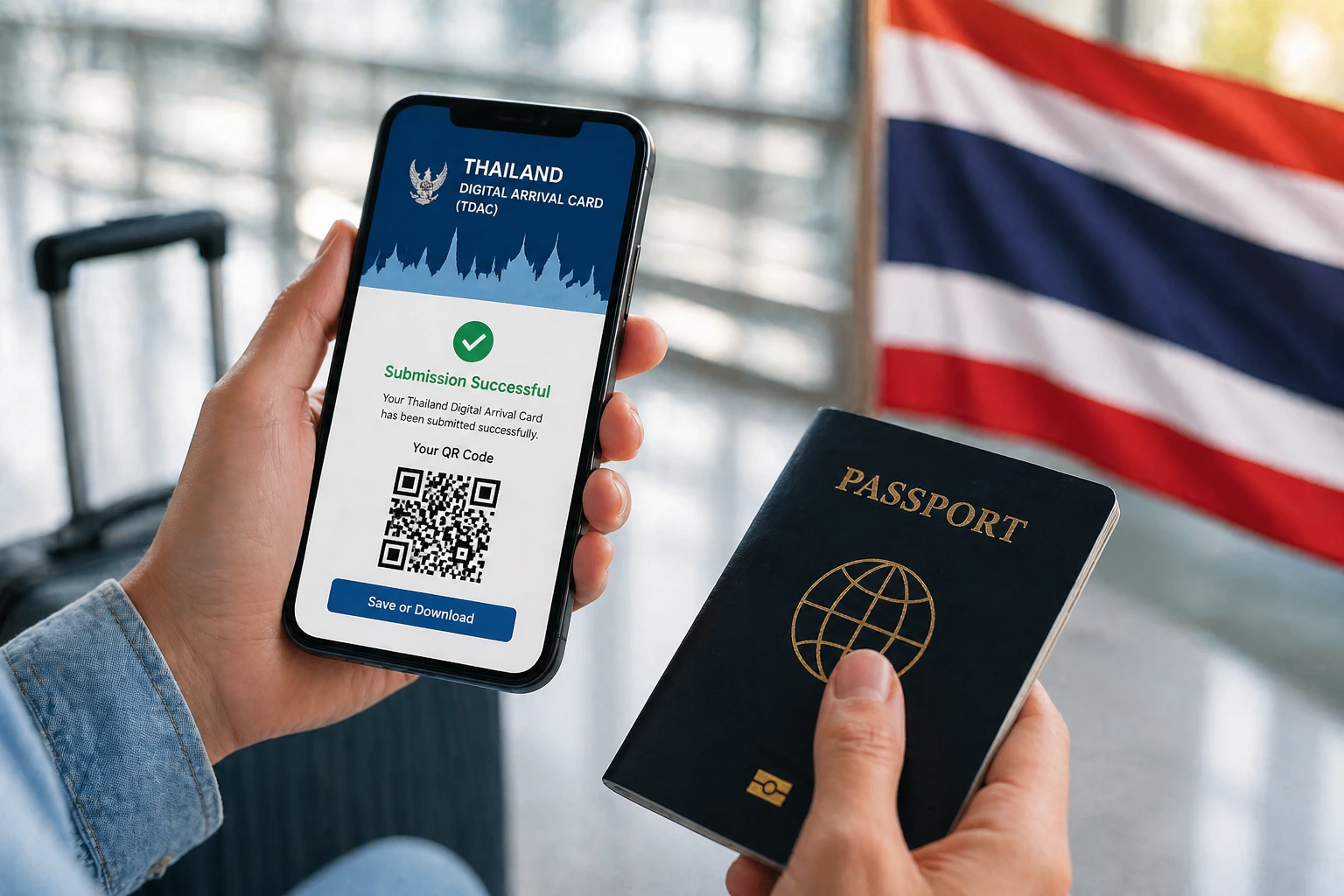
The paper TM6 form no longer exists. Since May 2025, every non-Thai national entering Thailand by air, land, or sea must submit the Thailand Digital Arrival Card before arrival. It is free, takes under 10 minutes if your documents are ready, and the only official place to complete it is tdac.immigration.go.th.
What you need:
- Passport details entered exactly as printed in the MRZ, the two-line code at the bottom of your photo page
- Your flight number and the date you land in Thailand
- A specific accommodation address, not just a city name
- An email address where the QR code will be sent
The submission window opens 72 hours before your arrival date. Submissions made more than 72 hours in advance are blocked. The date that matters is when your flight lands in Thailand, not when you depart your origin country. If your flight crosses midnight, check which calendar date your arrival falls on.
Once submitted, you receive a QR code by email. Save it as a screenshot and as a PDF before you board. Airport Wi-Fi at both BKK and DMK is inconsistent during peak hours. Do not count on being able to open your email after landing.
Airlines have begun checking for the TDAC at departure check-in, not just at Thai immigration. Having it ready before you reach the check-in desk removes one possible delay.
One detail that does not appear in most guides: you must submit a new TDAC for every entry into Thailand, including short re-entries. If you cross to Malaysia or Cambodia and return, a new submission is required regardless of how recently you completed the last one.
Who is exempt: passengers transiting airside who do not pass through immigration. If you are connecting to another flight without entering Thailand, no TDAC is required.
Immigration: What to Expect at the Counter
At Suvarnabhumi (BKK)
The immigration hall at BKK is large and generally moves at a reasonable pace during mid-morning and afternoon arrivals. Outside peak hours, expect 20 to 40 minutes from the queue to exit. As of early 2026, Automated Border Control gates are available to eligible passport holders, shortening processing time significantly for those who qualify.
Peak congestion occurs in the evening when multiple long-haul flights from Europe, the Middle East, and East Asia arrive within the same window. If your flight lands between 20:00 and 23:00, allow extra time.
Have the following ready at the counter: TDAC QR code, passport, accommodation confirmation, and a return or onward ticket. Officers occasionally ask for proof of funds. Keep the THB 10,000 equivalent accessible, not buried in a bag.
At Don Mueang (DMK)
DMK's immigration hall is smaller with fewer counters. The critical window is 22:00 to 02:00, when budget carrier waves from across Southeast Asia arrive simultaneously. At DMK during this late-night window, plan for up to two hours. Having your TDAC QR code open before you reach the counter is the one variable within your control.
Airport Comparison at a Glance
| Factor | Suvarnabhumi (BKK) | Don Mueang (DMK) |
|---|---|---|
| Primary carriers | Full-service international | AirAsia, Nok Air, Thai Lion Air |
| Immigration hall | Large, multiple counters | Smaller, fewer counters |
| Automated gates | Available (select passports) | Limited |
| Peak congestion | Evening long-haul arrivals | 22:00 to 02:00 |
| SIM counters | 24-hour, multiple operators | AIS and TrueMove + 7-Eleven |
| Train to the city | ARL (45 THB, 26 min) | Red Line (14 to 33 THB) |
| Taxi to Sukhumvit | 350 to 500 THB + tolls | 300 to 450 THB + tolls |
SIM Card: Physical SIM or eSIM, and Which Provider
There is no airport surcharge at BKK or DMK SIM counters. Prices are the same as anywhere else in Thailand. If you are not in a hurry, SIM cards are widely available in the city at the same price. Buying at the airport is about convenience, not necessity. The decision is not where to buy but what to buy and from whom.
Choosing your setup:
- Staying 1 to 2 weeks and visiting islands or rural areas: AIS physical tourist SIM. Widest nationwide coverage, including remote areas and smaller islands where other networks drop.
- Staying in Bangkok, Chiang Mai, or Phuket only: TrueMove or AIS. Both perform well in cities. The difference for urban travel is minimal.
- Your phone supports eSIM, and you want connectivity before clearing customs: purchase an AIS eSIM, an Airalo plan, or a Nomad plan online before departure and activate it on landing.
- Remote worker or heavy data user staying 30 days: TrueMove or AIS 30-day unlimited plan at 1,199 THB.
SIM Comparison Table
| Provider | 8-Day Plan | 15-Day Plan | 30-Day Plan | Best For |
|---|---|---|---|---|
| AIS | 499 THB | 699 THB | 1,199 THB | Island and rural travel, the widest coverage |
| TrueMove | 399 THB | 699 THB | 999 THB | City-focused trips |
| DTAC (via True Corp) | 299 THB | 599 THB | 1,199 THB | Short stays, budget |
| eSIM (Airalo/Nomad) | Variable | Variable | Variable | Pre-arrival setup, eSIM-compatible phones |
At the counter: Show your passport, choose a plan, and the staff handles activation and installation. Allow 10 to 15 minutes. Some kiosks at DMK are cash only. ATMs in the arrivals hall charge approximately 220 THB per transaction for international cards, which can erode the price advantage of a local SIM over an eSIM purchased before travel.
Thai law requires all SIM cards to be registered to a passport. Staff handles this automatically at the counter. Unregistered SIMs are deactivated within days of purchase.
Getting Into Bangkok
From Suvarnabhumi (BKK)
Airport Rail Link
The ARL station is on Level B, the basement of the terminal, clearly signed from the arrivals hall. A single ticket to Phaya Thai costs 45 THB, and the journey takes 26 minutes. Phaya Thai connects directly to the BTS Skytrain. Makkasan station, one stop earlier at 35 THB, connects to the MRT Blue Line. The train runs from 05:30 to midnight every 12 to 15 minutes. Contactless card payment has been accepted at the turnstiles since late 2025.
This option works well for travelers with manageable luggage staying near a BTS or MRT station. For a hotel that requires two connections and a final taxi, the total cost and time can approach that of a direct Grab.
Metered Taxi
Official taxis are on Level 1, Gates 4 to 7 (inner curb). Collect a queue ticket from the machine before boarding. Fare structure: meter starting at 35 to 40 THB, plus a flat 50 THB airport surcharge, plus expressway tolls of 50 to 100 THB depending on route. Total to Sukhumvit or Silom: 350-500 THB.
If a driver approaches you in the terminal or proposes a fixed price before you reach the official queue, decline and return to the queue. Metered rides to central Bangkok run 350 to 500 THB. Flat-fare offers from touts typically run 500 to 800 THB for the same journey. Travel time by road varies significantly with traffic. A taxi from BKK to Sukhumvit can take 25 minutes late at night or over an hour during peak hours. The official pickup point is detailed on the Suvarnabhumi Airport transport page.
Grab
The designated Grab pickup point is Level 2, Gate 4 (outer curb), clearly marked and signed. Fares to central Bangkok run 400 to 650 THB, depending on time and traffic. During weekday peak hours between 16:00 and 19:00, surge pricing can push fares to 700 THB. Outside peak hours, Grab fares are comparable to metered taxis with the benefit of a confirmed price before you board. Set up the app and add a payment method before landing.
Airport Bus (S1)
60 THB direct to the Khao San Road and Old Town area. Slower than all other options due to multiple hotel stops along the route. Practical if your accommodation is in that part of the city and your arrival time is not a factor.
From Don Mueang (DMK)
Red Line Train
A covered, air-conditioned walkway connects Terminal 1 directly to Don Mueang station. Fares range from 14 to 33 THB depending on the destination. The train connects to Bang Sue Grand Station, where you transfer to the MRT. Runs from approximately 05:30 to midnight.
A1 Bus to BTS Mo Chit
30 THB, runs every 10 to 15 minutes, and connects to the BTS Skytrain network at Mo Chit. Practical for travelers who are comfortable with one transfer and do not carry heavy luggage.
Metered Taxi
Same rules apply as BKK: official queue, meter on, no flat fares. DMK is slightly closer to the city center than Suvarnabhumi. Fares to central Bangkok range from 300 to 450 THB, plus a 50 THB surcharge and tolls.
How to Choose Your Transport
- Traveling light, arriving before midnight at BKK: Airport Rail Link to Phaya Thai or Makkasan, then BTS or MRT onward.
- Traveling light, arriving before midnight at DMK: Red Line train to Bang Sue Grand, then MRT onward.
- Luggage-heavy, hotel near a BTS or MRT station: ARL or Red Line to nearest interchange, short taxi onward. The total cost is often comparable to a direct taxi.
- Group of three or more with luggage: a direct metered taxi or Grab can cost less per person than a train plus individual taxis at the other end.
- Arriving between 01:00 and 05:30 at either airport, ARL and Red Line are not running. Use Grab or the official metered taxi queue. Late-night Grab is generally reliable, though surge pricing can apply during the 01:00 to 03:00 window when multiple flights land simultaneously.
- Arriving at DMK after midnight on a budget: the terminal has a 24-hour area where you can wait for the first Red Line service at 05:30.
Once you have transport sorted and know which part of Bangkok you are heading to, planning your first two weeks in Thailand will help you sequence the rest of your trip.
What Most Arrival Guides Get Wrong
Two errors appear consistently across Thailand arrival guides.
The first is treating both Bangkok airports as interchangeable. They are not. Suvarnabhumi and Don Mueang are distinct environments with varying passenger volumes and peak congestion patterns. DMK at 23:30, when three AirAsia flights have just landed, is not the same as BKK on a quiet Tuesday afternoon. If you are arriving late on a budget carrier, build queue time into your plans rather than assuming a thirty-minute process.
The second is presenting the Airport Rail Link as the universally correct choice. It is not. For a solo traveler with carry-on luggage staying near Phaya Thai or Asok, it often works well. For two people with checked bags staying near Silom, the ARL plus a taxi at the other end can cost nearly as much as a direct Grab, take longer total, and add friction with luggage on a crowded train. The right transport choice depends on where you are staying, what you are carrying, and when you arrive. There is no single correct answer.
Who This Guide Is Not For
This guide covers air arrivals at Bangkok's two international airports. It does not address:
- Land border crossings into Thailand: the TDAC applies, but the physical process and queue structure differ by crossing point
- Regional airport arrivals in Phuket, Chiang Mai, Koh Samui, or Hat Yai: TDAC and SIM card processes are identical, but transport options vary significantly
- Visa-on-arrival applicants: that queue runs before standard immigration and adds 30 to 60 minutes; the process warrants its own dedicated guide
If you are still deciding which part of Thailand to fly into based on your itinerary, the Thailand 2-week itinerary guide covers logical entry and exit points by route.
Closing Thought
The arrival process in Thailand in 2026 is more digital and more consistent than it was three years ago. The TDAC replaced a paper form. Automated border control has expanded. Grab operates from a designated pickup point. The variables that remain are the ones that have always existed: what time you land, which airport you use, and how much luggage you have.
Arrive with your TDAC QR code saved offline, your passport accessible, and a clear sense of which transport option fits your situation. That removes most of the friction people experience on arrival.
FAQ
Do I need to complete the TDAC before flying to Thailand?
Yes. The Thailand Digital Arrival Card must be submitted to tdac.immigration.go.th at least 72 hours before arrival. It is free and permanently replaces the old TM6 paper form. You receive a QR code by email on submission. Save it offline as a screenshot and a PDF backup before boarding. Airlines are now checking for it at departure check-in, not only at Thai immigration.
How much cash do I need at the Thailand immigration?
Immigration officers may ask for proof of funds. The standard threshold is THB 10,000 per person or THB 20,000 per family. This does not need to be physical cash; accessible funds shown in a bank app or on a card generally satisfy the requirement. Having some Thai baht available for your SIM card and first transport remains practical regardless of how you plan to show funds.
Where do I buy a SIM card at the Bangkok airport?
AIS, TrueMove, and DTAC counters are in the arrivals halls at both Suvarnabhumi and Don Mueang and are open 24 hours. Prices match those in the city; there is no airport surcharge. Bring your passport, as registration is required by Thai law. The AIS 8-day unlimited tourist SIM costs 499 THB and reliably covers cities, islands, and rural areas.
What is the cheapest way from Suvarnabhumi Airport to central Bangkok?
The Airport Rail Link costs 45 THB to Phaya Thai station and takes 26 minutes. It runs from 05:30 to midnight. From Phaya Thai, you connect directly to the BTS Skytrain. A metered taxi to central Bangkok costs 350 to 500 THB, including the 50 THB airport surcharge and expressway tolls of 50 to 100 THB. The bus (S1 route) costs 60 THB but is considerably slower.
Is Grab available at Bangkok airports?
Yes. At Suvarnabhumi, the designated Grab pickup point is Level 2, Gate 4, and the service operates 24 hours. Fares to central Bangkok typically run 400 to 650 THB. Surge pricing during weekday peak hours between 16:00 and 19:00 can push fares higher. Set up the app and add a payment method before arriving to avoid delays at the pickup point.
Further Planning
- Thailand 2-Week Itinerary: Best Route for 14 Days 2026
- Best Places to Visit in Thailand 2026
- Questions or corrections: contact via southeastasiasimplified.com