
If you are traveling between May and September, Koh Samui is usually the better choice. If you are traveling between November and April, Phuket is typically the safer option. Everything else follows from that.
Quick Take
Best for direct international access: Phuket (Phuket International Airport, HKT)
Best for resort immersion and smaller scale: Koh Samui
Best months for Phuket (Andaman coast): November to April
Best months for Koh Samui (Gulf of Thailand): December to August
Biggest planning mistake: Choosing based on which flights are cheaper rather than which island is in dry season during your travel window
Worst month for Phuket: September
Worst month for Koh Samui: November
Who should not read further: If Krabi is also in consideration alongside these two, the three-way comparison on this site covers all three with the same level of detail
Travel forums and aggregator guides tend to frame this comparison the same way: Phuket is bigger and busier, Koh Samui is smaller and more relaxed. That framing is not wrong, but it skips the one factor that should anchor the decision before anything else. These two islands sit on opposite coasts of southern Thailand, governed by different monsoon systems that operate on almost opposite seasonal cycles. Get that timing wrong, and no amount of careful resort research will compensate.
This guide first covers that foundational fact, then addresses access, accommodation tier, beach character, building scale, traveler fit, and cost.
The Geography That Drives Everything
Koh Samui sits in the Gulf of Thailand on the east coast. Phuket sits on the Andaman Sea on the west coast. These two positions mean they are governed by entirely different monsoon systems that operate in near-opposite rhythms throughout the year.
The southwest monsoon, running roughly from May through October, hits Phuket and the Andaman coast directly. The west-facing beaches take the full force of it: rough seas, persistent rain, and poor underwater visibility. Koh Samui, sheltered on the east coast, barely registers it. The northeast monsoon, arriving roughly from November through January, flips the equation. The Gulf of Thailand takes the weather: Koh Samui has its wettest months from October through December, with November being the most disruptive. Meanwhile, Phuket is dry and entering its best tourist season.
Here is where it becomes practical. A traveler in July faces opposite conditions on each island. During that month, the Andaman monsoon is well established, and Phuket is not at its best for beach holidays. Koh Samui's Gulf-facing position keeps it largely sheltered, with warm temperatures and mostly calm seas. That same traveler planning a December or January trip faces the reverse: Phuket's Andaman coast is bone dry while Koh Samui is finishing the tail end of its wet season.
Season-by-season breakdown:
| Month | Phuket (Andaman) | Koh Samui (Gulf) | Recommended |
|---|---|---|---|
| January | Peak season, calm seas | Dry, excellent | Both viable |
| February | Prime month, best conditions | Dry, peak season | Both viable |
| March | Excellent | Still very good | Both viable |
| April | Good, transition approaching | Warm, slight showers | Both viable |
| May | Rain building | Calm, good | Koh Samui |
| June | Low season, rough seas | Warm, mostly sunny | Koh Samui |
| July | Monsoon, avoid if possible | Good conditions | Koh Samui |
| August | Monsoon | Good conditions | Koh Samui |
| September | Worst month | Rains increasing | Neither ideal |
| October | Improving late in the month | Wettest period beginning | Avoid both |
| November | Dry season begins | Soggiest month | Phuket |
| December | Peak season | Rain subsiding | Phuket |
The months when both islands align positively are January, February, and March. For a multi-island trip, this window offers the best of both coasts without compromise. October is the month when neither coast is at its best, and inland destinations like Bangkok or Chiang Mai serve visitors better.
Getting There: The Access Gap Is Real
This distinction becomes operationally significant for travelers flying from Europe, the Middle East, or long-haul international routes.
Phuket (HKT) operates as Thailand's second-busiest international airport. Direct routes connect it to London, Frankfurt, Dubai, Singapore, Hong Kong, and most major Asian hubs. Multiple carriers compete on these routes, which keeps fares competitive and gives travelers genuinely flexible booking options.
Koh Samui (USM) is a different situation. Samui International Airport is privately owned by Bangkok Airways, and this gives the airline near-exclusive control over flights to the island. There are no budget carrier alternatives flying directly into USM, and no long-haul international flights from outside the region.
For travelers routing from Europe, the US, or the Middle East, Koh Samui requires a connecting flight through Bangkok, and that connection will almost certainly involve Bangkok Airways at Bangkok Airways pricing. In practice, travelers end up on this airline due to limited alternatives rather than preference.
The pricing consequence is straightforward. Round-trip fares on the Bangkok to Samui route are routinely priced above what competitive multi-carrier routes to Phuket cost at equivalent cabin classes. Travelers who compare the two islands by looking only at the Phuket fare, without factoring in the Bangkok Airways connecting leg to Samui, tend to underestimate the true cost difference.
One alternative is to fly into Surat Thani on the mainland via budget carriers like AirAsia, then connect by bus and ferry to Koh Samui. This route saves money but adds several hours to the journey and introduces transfer complexity that travelers with families or significant luggage often find impractical.
Access summary:
| Factor | Phuket (HKT) | Koh Samui (USM) |
|---|---|---|
| Long-haul direct international flights | Yes | No |
| Budget carrier access | Yes, multiple options | No direct |
| Airline competition on routes | High | Very limited |
| Transfer time to main resort areas | 30 to 75 minutes | 20 to 45 minutes |
| Alternative land/sea access | Via the Sarasin Bridge from the mainland | Ferry from Surat Thani or Don Sak |
The Beach Experience: Range vs. Consistency
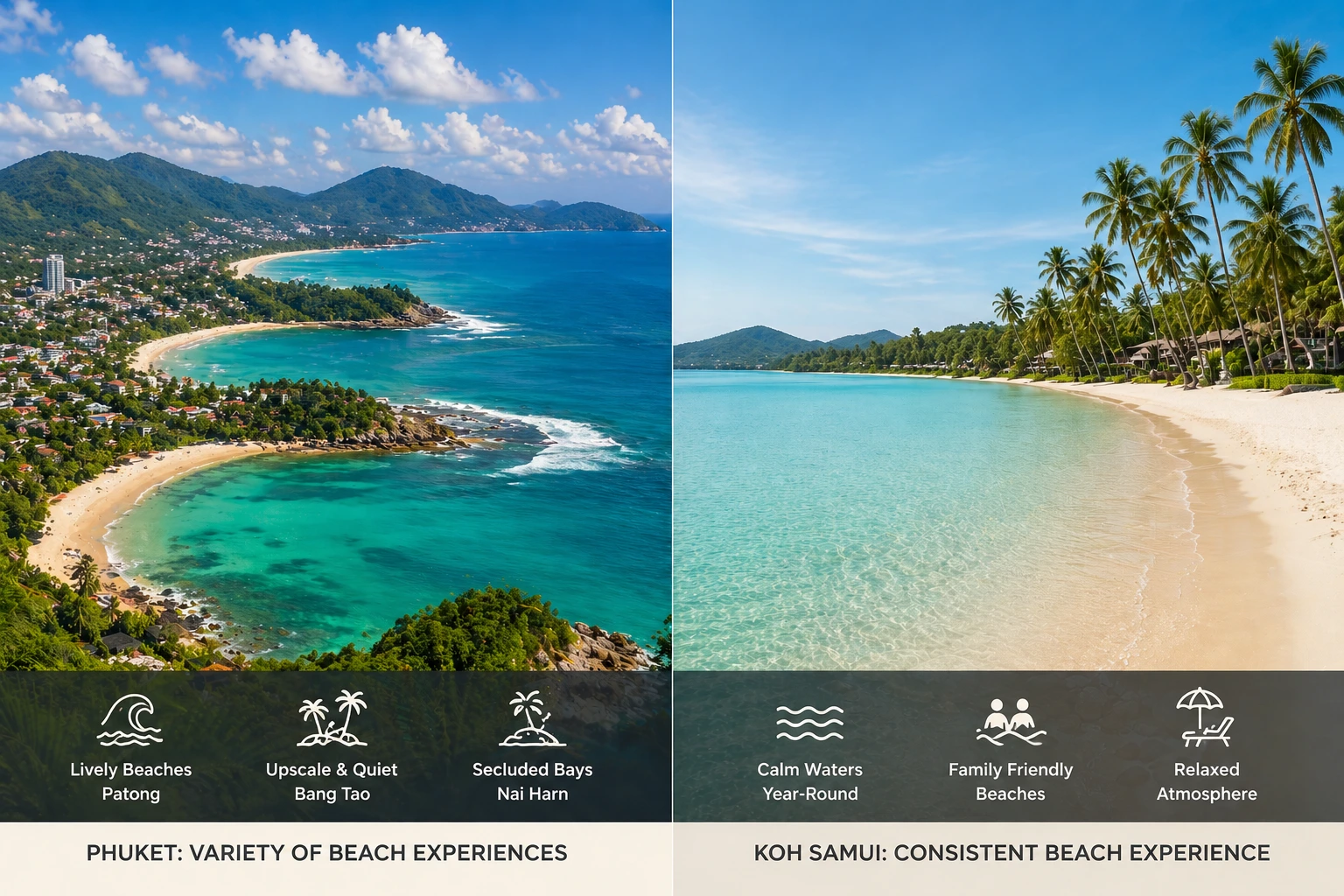
Phuket has over 35 beaches, each with a distinct character. This variety is genuinely useful for travelers whose group has mixed preferences, but it also means that choosing the wrong area in Phuket can lead to a significantly different trip. Patong and Bang Tao are not interchangeable experiences. Patong is one of Thailand's most commercially dense beach strips; Bang Tao and Surin, a short drive north, are quieter and upscale in feel.
Koh Samui's beaches are generally characterized by softer sand, calmer water, and more consistent conditions. The Gulf of Thailand's gentler sea state makes Samui's beaches swimmable across a wider portion of the year, particularly along the north and central coastlines. Beaches like Choeng Mon and Mae Nam on the island's north coast offer shallow, calm waters that work well for families with young children. For complete seclusion, Lipa Noi on the west coast sees very little traffic.
One structural difference shapes the visual feel of both islands. Phuket has high-rise development along several of its beach strips, particularly around Patong and Karon. Koh Samui operates under strict building regulations enforced since 2014: within the first 50 meters of the high-tide line, structures are capped at 6 meters in height. Even farther from the beach, the 12-meter ceiling applies to most zones. As a result, even in Samui's busier areas, the resort scale remains low-rise. Beaches feel less built-up, and the landscape retains a palm-tree character that higher-density development removes.
For travelers who find beach strip density unappealing, this is a meaningful distinction, not just a cosmetic one.
For a detailed breakdown of which Phuket beaches suit which traveler type, the Phuket beach guide on this site covers each stretch in full.
Resorts and Accommodation: Breadth vs. Intimacy
Both islands carry strong luxury credentials. The difference lies in scale, competition, and the private villa market.
Phuket's luxury tier is Thailand's most developed. The island has over 1,200 properties ranging from budget guesthouses to five-star beachfront resorts, and the top tier is genuinely world-class. Amanpuri, on a private peninsula on Phuket's west coast, was among the first Aman properties in Asia and remains a benchmark for understated luxury and privacy. Trisara, on the quieter northwest coast, holds a Michelin star at its PRU restaurant and operates 48 ocean-facing pool villas across its own private bay. Rosewood Phuket, Banyan Tree, and the Sri Panwa Cape Resort complete the upper bracket.
The private villa rental market is substantial. Options range from two-bedroom properties in the Surin and Bang Tao corridor to twelve-bedroom compound rentals designed for groups. Higher supply keeps prices competitive relative to comparable villa markets in the region.
Koh Samui's luxury tier is more boutique in character. The Four Seasons Resort Koh Samui, on the island's northeast coast, became globally prominent as the filming location for White Lotus Season 3. The property sits on a private peninsula with 60 villas and 10 private residences, each with Thai-inspired décor, private decks, and sea or garden views. The director of the series reportedly chose the property within 30 seconds of arriving, describing it as a place with character and spirituality. That description captures something genuine about Samui's upper-tier accommodation: it tends toward intimacy and integration with landscape rather than scale and spectacle.
Samui's boutique accommodation scene means fewer properties at the ultra-luxury end, and fewer budget options at the lower end. Travelers who want the widest possible choice within a single destination will find Phuket better supplied. Travelers who want a contained, resort-anchored experience at a consistently elevated level will find Samui well-suited.
Accommodation cost anchors:
| Category | Phuket (approx. THB per night) | Koh Samui (approx. THB per night) |
|---|---|---|
| Mid-range hotel | 3,000 to 8,000 | 3,500 to 9,000 |
| Luxury resort entry | 12,000 to 25,000 | 12,000 to 22,000 |
| Ultra-luxury and top tier | 35,000 to 100,000+ | 30,000 to 80,000+ |
| Private villa (2BR, pool) | 15,000 to 40,000 | 18,000 to 45,000 |
These figures are planning anchors, not guarantees. Peak season from December through February pushes rates meaningfully higher on both islands.
Activities and Excursions: Range vs. Depth
Phuket's position on the Andaman Sea gives it access to some of Thailand's most celebrated marine environments. The Similan Islands, accessible via liveaboard from November to May, rank among the best dive sites in Southeast Asia for visibility and marine biodiversity. Phang Nga Bay, with its limestone karst formations and James Bond Island, is accessible via day trip or private boat charter from Phuket's marinas.
For travelers interested in private boat excursions around Phuket and the surrounding waters, the Phuket private boat tour guide on this site outlines the full range of options.
Beyond water access, Phuket Town adds a cultural dimension that Samui cannot match. The Sino-Portuguese architecture of the Old Town, the Sunday Night Walking Street market at Lard Yai, and the depth of the local food scene give Phuket character beyond resort life. Areas like Rawai, Chalong, and Kata retain a genuine local texture alongside the tourism infrastructure.
Koh Samui's strengths run in a different direction. The island offers private yoga sessions on secluded beaches, cliffside dining with panoramic Gulf views, and wellness experiences embedded in tropical landscapes. Access to Ang Thong National Marine Park, a 42-island archipelago accessible by boat, is one of Samui's genuinely distinctive assets. The Bophut Fisherman's Village Friday Night Market is the closest Samui comes to Phuket's street-level cultural life, and it is worth an evening, though it operates on a considerably smaller scale.
For a broader overview of Phuket's top sites beyond the beaches, the luxury traveler's guide to places in Phuket covers each one with planning depth.
What Most Destination Guides Get Wrong
The standard framing reduces this to: Phuket is bigger and busier, Samui is smaller and quieter. That is accurate at a surface level, but it misses the more useful structural difference.
Phuket offers travelers a wide range of options, but they must make good choices on the island. The gap between Patong and Nai Harn is not a minor variation in atmosphere. It is the difference between one of Thailand's most commercially dense beach strips and a genuinely relaxed bay with a local character and good seafood restaurants. Choosing Phuket without thinking about which area of Phuket is a planning gap.
Samui offers a narrower but more predictable range. The island is smaller, the beach character is more consistent, and the resort density is lower. Travelers who want to arrive, check in, and not manage logistics will find Samui accommodating. The trade-off is fewer alternatives when one experience stops appealing.
Neither island delivers a pristine, low-footprint environment. Travelers specifically seeking that profile should look to the Koh Yao Islands in Phang Nga Bay, accessible from Phuket, or to the quieter Gulf Islands farther north of Samui.
Who This Is Not For
Phuket is not suited for:
- Travelers whose entire trip falls in June, July, August, or September, when the Andaman monsoon is at its most disruptive
- Travelers sensitive to commercial beach strip environments who do not research which specific area of the island to stay in
- Travelers who want a fully contained, single-resort experience with minimal decisions about location within the island
Koh Samui is not suited for:
- Visitors flying long-haul from Europe, the US, or the Middle East who want to avoid a Bangkok stopover and the added cost of the Bangkok Airways connection
- Travelers wanting the widest possible range of excursions, dive sites, and off-island day trips
- Travelers whose travel window falls in October or November, when the Gulf monsoon produces Samui's heaviest and most disruptive rainfall
- Travelers who want multiple distinct beach environments within a single island
Traveler Profile: Quick Picker
Choose Phuket if:
- You are flying long-haul and want the most straightforward routing into Thailand
- Your travel window is November through April
- You want a large private villa, multiple beach options, or a base for Andaman island-hopping
- Cultural depth, food variety, and off-resort life matter to your itinerary
- You are traveling as a family and want structured activity options beyond the resort
Choose Koh Samui if:
- Your travel window is December through August, and reliable dry weather is the priority
- You want a contained, resort-anchored trip with minimal logistics
- Calm, swimmable water is important, particularly for young children
- You value low-rise, low-density resort environments
- The trip is a honeymoon or couples' stay where privacy and quiet define success
Consider both if:
- You have 12 days or more and want to experience both coasts
- Your trip falls in January, February, or March, when both islands are at their best simultaneously
Practical Cost Comparison
| Planning Item | Phuket (approx.) | Koh Samui (approx.) |
|---|---|---|
| One-way domestic flight from Bangkok | 1,200 to 3,500 THB | 3,000 to 7,500 THB |
| Mid-range resort per night | 5,000 to 15,000 THB | 5,500 to 14,000 THB |
| Private airport transfer | 1,200 to 2,500 THB | 800 to 1,800 THB |
| Meal at a mid-range restaurant | 300 to 800 THB | 350 to 850 THB |
| Private day boat charter | 12,000 to 30,000 THB | 10,000 to 25,000 THB |
The clearest cost gap is in the air. Limited competition on routes to Koh Samui means the Bangkok-to-Samui leg reliably costs more than the equivalent domestic routing to Phuket, where AirAsia, Thai Lion Air, and Thai Airways compete on the same corridor. Accommodation pricing is broadly comparable across equivalent tiers, with Phuket offering more competitive pricing at the mid-range due to higher supply.
FAQ
Is Phuket or Koh Samui better for a honeymoon?
Both islands suit couples well, and the answer depends on travel timing and travel style. Koh Samui, with its lower resort density, low-rise building character, and more contained scale, tends to suit couples who want seclusion and minimal decisions. Phuket offers more options for couples who want to combine romance with excursions, private boat charters, or fine dining. For trips falling between December and August, Samui's Gulf-side weather reliability gives it a practical edge for honeymooners who cannot afford a monsoon disruption.
Which island is cheaper overall?
Phuket is generally the more cost-competitive destination. Supply volume drives more competitive accommodation pricing at the mid-range level, and multi-carrier route competition into Phuket International Airport yields noticeably lower fare floors than the near-exclusive Bangkok Airways routing to Samui. The cost difference is most visible in the domestic flight leg.
When is the best time to visit Koh Samui vs Phuket?
Visit Phuket between November and April. Visit Koh Samui between December and August. October is a transitional month with disruptive weather on both coasts and is better spent in Bangkok, Chiang Mai, or elsewhere in northern Thailand. January, February, and March are the only months when both islands are reliably excellent simultaneously.
Is Koh Samui or Phuket better for families?
Koh Samui generally offers a calmer, more contained environment for families. Beaches like Choeng Mon and Mae Nam have shallow, calm water suitable for young children, and the island's smaller scale makes logistics easier to manage. Phuket suits families who want structured activity options beyond the beach, including water parks, aquariums, and cultural sites in Phuket Town, provided the accommodation area is chosen carefully. Patong, specifically, is not well-suited to family holidays.
Can you visit both Phuket and Koh Samui in one trip?
Yes, though it requires planning. There is no direct flight between the two islands. The practical routing is Phuket to Bangkok, then Bangkok Airways to Koh Samui, which adds flight time and cost. Some travelers take the mainland ferry route through Surat Thani, which saves money but takes up most of a travel day. For trips of 12 days or more, visiting both is worthwhile. For shorter trips, splitting time between the two often means too little time to properly settle into either.
Closing
The decision between Phuket and Koh Samui is less about preference and more about timing. Choose the island that is in its dry season during your travel window, and most of the other decisions become considerably easier. Get that wrong, and even the best resort cannot compensate for rough seas and persistent rain.
Further Planning
- Phuket vs Krabi vs Koh Samui: If Krabi is also in consideration, the three-destination comparison covers all three with the same operational detail
- Phuket beaches by traveler type: The Phuket beach guide maps each beach to the traveler profiles it actually suits
- Phuket boat excursions: The private boat tour planning guide covers Phang Nga Bay, island-hopping options, and what each charter type delivers