
Thailand's domestic network is hub-dependent, airport-split, and route-specific in ways that only become visible once an itinerary no longer fits together. The standard advice ("book early, it's cheap") is not wrong. It just describes the easy part. This article focuses on what actually determines whether flying saves time or adds friction: which corridors function reliably, which are subject to structural constraints, and how to sequence a multi-destination trip around the network rather than against it.
Quick Take
- Best-value route: Bangkok (DMK) to Chiang Mai. 10+ daily departures, LCC fares from approximately 1,200 THB one-way, 1-hour flight time, served from both Bangkok airports
- Most misunderstood route: Bangkok to Koh Samui. Operates exclusively via Suvarnabhumi (BKK) on Bangkok Airways; no LCC access; one-way fares typically 3,000–6,000+ THB; this is a structural cost, not a seasonal one
- Worst mistake: Booking a domestic departure from Don Mueang (DMK) on the same day as an international arrival at Suvarnabhumi (BKK) without allowing a minimum 4–5 hour buffer
- Where schedules thin out: Krabi and southern routes reduce frequency from May through October, which affects reliability, not just price
- Avoid: Non-refundable LCC base fares on once-daily routes (Chiang Mai to Krabi, Chiang Mai to Phuket). A single cancellation breaks the itinerary with no fast recovery
This article is built around planned, multi-destination itineraries. Travellers expecting spontaneous same-day bookings, budget fares with full flexibility, or seamless north-to-south connections without a Bangkok leg will find that the network itself is the constraint, and that this needs to be addressed before routes are selected.
The Short Answer
Thailand's domestic network is radial, not grid-based. Bangkok sits at the centre. The high-frequency routes (Bangkok to Chiang Mai, Bangkok to Phuket, Bangkok to Krabi) work reliably and carry competitive fares. Point-to-point routes between regional airports exist but run on limited schedules and are fragile under timing pressure. Whether Bangkok functions as friction or as a planned overnight in your itinerary is a decision worth making early, before flights are booked, not after.
How the Network Is Actually Structured
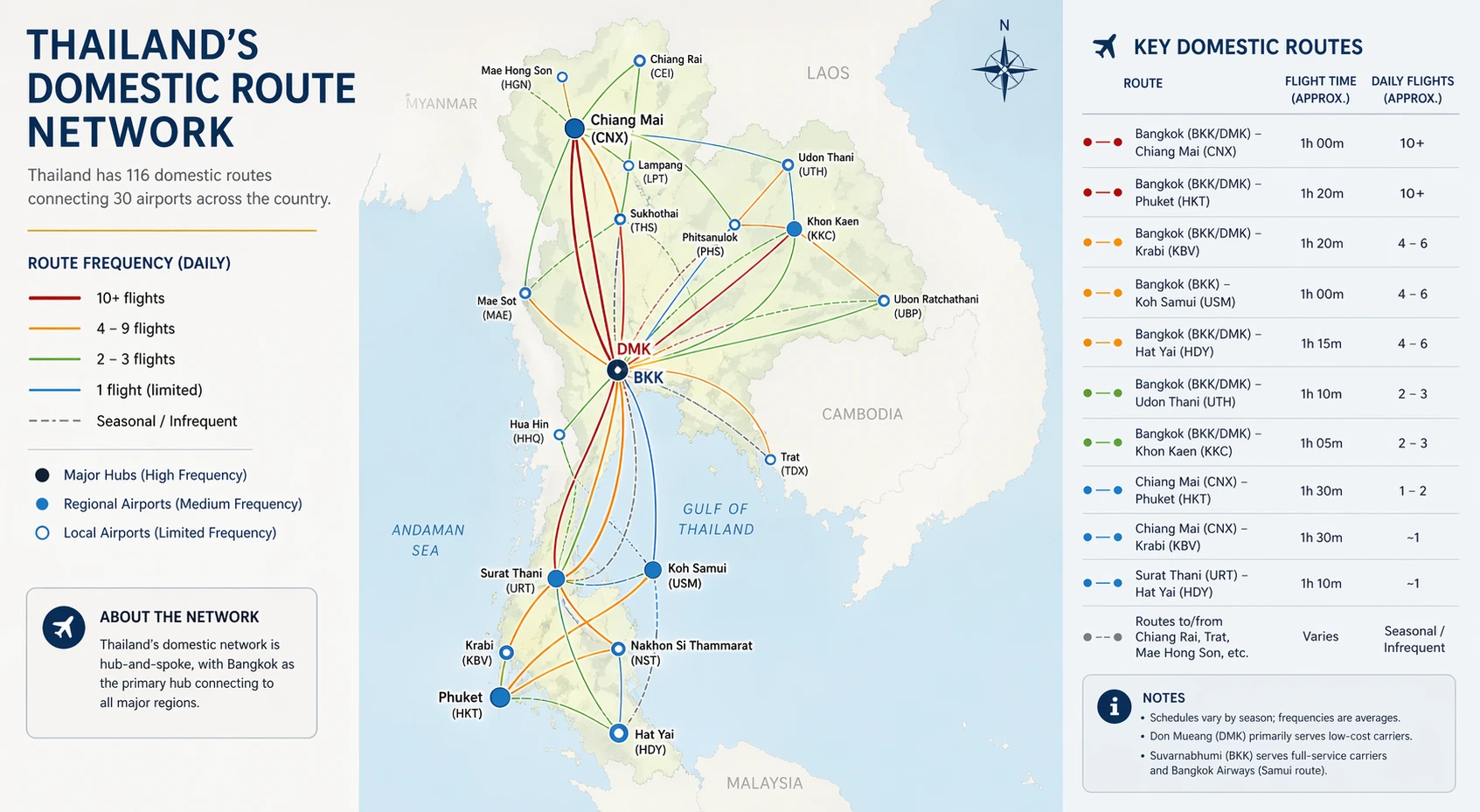
Thailand has 116 domestic routes connecting 30 airports. The practical capacity, however, concentrates on six to eight core corridors. Everything else runs on thinner schedules with fewer aircraft and less buffer when disruptions occur.
Bangkok operates two airports with distinct carrier profiles that are not interchangeable.
Don Mueang (DMK) is the primary base for Thailand's low-cost carriers: Thai AirAsia, Nok Air, Thai Lion Air, and Thai Vietjet Air. These airlines handle the majority of domestic volume at price-competitive fares. If you are booking an LCC domestic connection, it will almost certainly operate from DMK.
Suvarnabhumi (BKK) handles Thai Airways and Bangkok Airways domestic routes. It also processes the majority of long-haul international arrivals into Thailand. Both functions (international gateway and full-service domestic hub) share the same terminal infrastructure.
This split is where most itinerary problems begin.
Route-by-Route Breakdown
Bangkok to Chiang Mai
The most competitive domestic corridor in Thailand. High frequency (10 or more daily departures), served from both BKK and DMK, with LCC fares from approximately 1,200–2,500 THB one-way. Flight time is around one hour.
This is the clearest case in Thailand where flying is the correct decision over any surface alternative when time has a value. An overnight train from Bangkok to Chiang Mai takes 12–15 hours; the flight takes one. For most travellers on a structured itinerary, the comparison is not close.
Bangkok to Phuket
Equally high-frequency and price-competitive. Both Bangkok airports are served. LCC fares run approximately 1,100–2,200 THB one-way. Flight time is around 1 hour and 20 minutes.
One planning detail that matters: Phuket International Airport sits in the north of the island, approximately 32–45 kilometres from most resort areas. Ground transfer times are entirely road-dependent. During December and January, traffic on Route 402 can add 20–45 minutes to what would otherwise be a straightforward transfer. Pre-arranged private transfers are the reliable solution; taxi queues at the terminal run long during peak arrival windows.
Bangkok to Krabi
Fewer daily departures than Phuket (typically four to six) and subject to seasonal schedule reductions in the low season. Fares are broadly comparable to the Phuket route.
Krabi's airport is smaller, ground transfer options are more limited, and reaching Railay Beach requires a road transfer to Ao Nang pier followed by a longtail boat. That adds approximately 40–50 minutes to the journey after landing. For a well-spaced itinerary, it is unremarkable; for a tight one, it is the variable that breaks the day.
Bangkok to Koh Samui
This route operates differently from every other domestic corridor in Thailand, and the difference is structural rather than seasonal.
Samui Airport (USM) is privately owned and operated by Bangkok Airways. The airline holds exclusive commercial rights to operate flights there. All commercial flights route through Suvarnabhumi. Don Mueang is not an option on this route, and no low-cost carrier serves Samui.
One-way fares typically range from 3,000–6,000+ THB, and in peak season, that figure rises. Baggage is included in the fare, and the airport experience at Samui is notably quieter than Thailand's major hubs. Bangkok Airways also operates boutique lounges at both ends of this route. But the premium exists regardless of when you book, how far in advance you plan, or what loyalty status you hold. It is the cost of the route architecture, not a timing variable.
Chiang Mai to Phuket or Krabi (Direct)
These routes exist. Bangkok Airways operates approximately seven weekly CNX–KBV flights; Thai AirAsia covers both CNX–HKT and CNX–KBV. Flight time is around 1.5 hours, meaningfully shorter than routing through Bangkok.
The scheduling is the constraint. With one or two daily departures on a good day, these connections are useful when the timing confirms cleanly. They are not a structural foundation for a tight itinerary. A confirmed booking with a contingency is the correct approach. Building an entire north-to-south routing around this single connection without one is where itineraries unravel.
Regional Routes Beyond the Main Corridors
Hat Yai (HDY), Khon Kaen (KKC), Udon Thani (UTH), Ubon Ratchathani (UBP), and Chiang Rai (CEI) are served primarily by LCCs on lower-frequency schedules. These routes are relevant for specific itineraries (the northeast, the deep south, the Golden Triangle) but less relevant to the standard international visitor routing. The same principles apply: check frequency, confirm the schedule, and do not treat a once-daily connection as equivalent to a Bangkok corridor flight.
Route Comparison
| Route | Flight Time | Typical One-Way Fare (Planning Range) | Daily Frequency | Bangkok Airport | Carrier Tier |
|---|---|---|---|---|---|
| Bangkok – Chiang Mai | ~1 hr | 1,200–2,500 THB | 10+ | BKK + DMK | LCC or full-service |
| Bangkok – Phuket | ~1 hr 20 min | 1,100–2,200 THB | 10+ | BKK + DMK | LCC or full-service |
| Bangkok – Krabi | ~1 hr 20 min | 1,200–2,400 THB | 4–6 | BKK + DMK | LCC |
| Bangkok – Koh Samui | ~1 hr | 3,000–6,000+ THB | 4–6 | BKK only | Bangkok Airways only |
| Chiang Mai – Krabi | ~1 hr 30 min | 2,000–4,500 THB | ~1 (limited) | CNX to KBV | Bangkok Airways / AirAsia |
| Chiang Mai – Phuket | ~1 hr 30 min | 2,000–4,500 THB | 1–2 (limited) | CNX to HKT | LCC / Bangkok Airways |
Fares are indicative planning anchors. Peak season fares on high-demand routes can be significantly higher.
The Carrier Decision
The choice between LCCs and full-service carriers on Thai domestic routes is less about brand preference and more about what the route structure requires.
Thai AirAsia, Nok Air, Thai Lion Air, Thai Vietjet: 7 kg cabin baggage as standard. Checked baggage is charged separately as an add-on. No refunds on base fares. The cheapest published fares on these carriers are the most rigid. On high-frequency routes where the schedule gives you options if something goes wrong, this is a reasonable trade-off. On a once-daily connection, it is a meaningful risk.
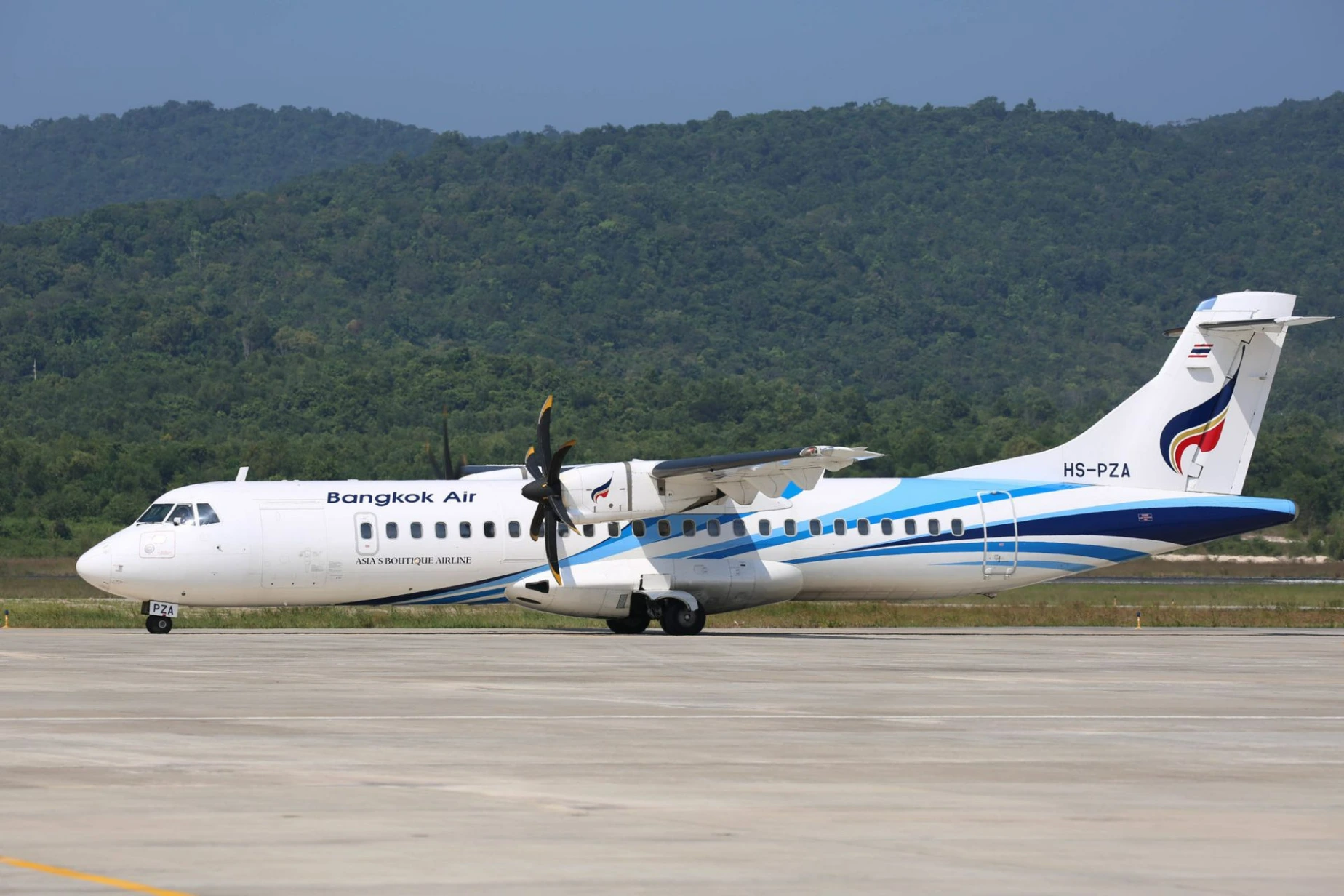
Bangkok Airways: 23–32 kg baggage included, depending on class. Boutique lounge access at Samui, Chiang Mai, and several other stations. Rebooking options available at a premium. Fares are consistently higher than their LCC equivalents, but the gap narrows once LCC add-ons are accounted for. On the Koh Samui route, there is no alternative.
Thai Airways: Full baggage inclusion. Premium domestic positioning. Operates from Suvarnabhumi. Relevant when the routing is already based in BKK and a full-service experience is preferred.
The decision should be made on a route-by-route basis, not as a blanket carrier preference.
The Bangkok Airport Transfer Problem
This is the most common source of first-day friction on multi-destination trips in Thailand, and it is entirely avoidable with early planning.
Don Mueang and Suvarnabhumi are separate airports with no direct rail link between them. The Red Line commuter rail connects Don Mueang to Bang Sue Central Station, and the Airport Rail Link connects Suvarnabhumi to central Bangkok, but there is no direct rail connection between the two airports. A proposed high-speed rail link remains stalled as of 2026 and should not be factored into current itinerary planning.
Road transfer through Bangkok traffic is the only option. The recommended minimum buffer is 4–5 hours. This accounts for ground transfer, check-in, and security at DMK. Bangkok traffic is the variable most people underestimate; it can double expected journey times during peak hours.
Understanding which airport serves your specific carrier is a foundational step. The full breakdown of airport functions, terminal infrastructure, and how each entry point maps to Thailand's regions is covered in the Thailand Airports Guide: Which One to Fly Into and Why It Matters. Which Bangkok airport you're routed through changes everything about how your domestic connections work.
The practical resolution for most itineraries: if your routing passes through Bangkok between an international arrival and a domestic departure, treat Bangkok as a planned overnight. Use the city as an itinerary night rather than a transit inconvenience. The friction disappears. The first morning in Thailand does not.
What Most Guides Get Wrong
The consistent gap in domestic flight advice is timing. High-frequency routes that carry competitive fares in March behave entirely differently in December or during Songkran.
From November through February, Thailand's peak international season, base fares on Bangkok–Phuket and Bangkok–Chiang Mai roughly double. Availability on popular departure times sells well in advance. Airlines add capacity (during Songkran 2026, the Civil Aviation Authority of Thailand coordinated with six carriers to add extra seats across 11 domestic routes), but that capacity fills quickly. Waiting for a better deal in December or January on a high-demand route is not a strategy that pays off.
The second gap is passenger rights. CAAT Notification No. 101, effective May 2025, strengthened domestic passenger protections. Compensation for domestic delays exceeding 5 hours has increased from 600 THB to 1,200 THB and is payable immediately. Cancellation compensation increased from 1,200 THB to 1,500 THB. Most travellers booking through LCC platforms are unaware that this protection exists, and the airlines are not inclined to advertise it.
The third gap is fair arithmetic. LCC base fares look competitive until checked baggage, seat selection, and any flexibility add-ons are included. On a route where Bangkok Airways charges 3,500 THB all-in and a comparable LCC charges 1,200 THB base plus 800 THB for a checked bag plus 300 THB for a seat, the gap is 1,200 THB. Meaningful, but smaller than the headline comparison suggests. On routes where both carriers operate, running the full comparison is worth the time.
How to Apply This in Practice
For a Bangkok–Chiang Mai–Southern Coast itinerary, the reliable sequencing is: fly into Bangkok on the international leg, take the northern route to Chiang Mai first, then head south to Phuket or Krabi. This structure avoids making the limited Chiang Mai-to-coast direct connection a scheduling dependency. It uses the high-frequency Bangkok corridors for both legs, with an overnight in Bangkok absorbing the airport transition cleanly.
For Koh Samui: price the Bangkok Airways fare at the planning stage. The premium is fixed in the route, not a function of timing. If the Gulf Coast is the destination and budget is a meaningful constraint, the alternative is to fly to Surat Thani (URT) and take a ferry. It is a longer journey, but with access to LCC fares.
For north-to-south direct connections: confirm the schedule first. If the once-daily Chiang Mai–Krabi flight fits the itinerary, use it. It is a genuine time-saver. If it requires the itinerary to bend around its schedule, the Bangkok routing is more reliable.
When Flying Is Not the Best Option
The network bias in this article runs toward air travel because that is the topic. Thailand, however, has several corridors where flying is the less rational choice, and naming them avoids over-engineering a trip with unnecessary flights.
Bangkok to Ayutthaya: Ayutthaya has no commercial airport. The train from Bangkok's Hua Lamphong or Bang Sue station takes 1.5 hours and deposits you close to the historical park. This is a day trip or one-night stop, not a flight connection.
Bangkok to Hua Hin: Hua Hin has a small airport with very limited scheduled service. The practical options are a private car (approximately 3 hours), a bus from Mo Chit (around 3.5 hours), or a train. For a coastal stop primarily accessed from Bangkok, road or rail is the standard approach. Flight logistics here add time, not remove it.
Bangkok to Kanchanaburi: Road is the only sensible option, approximately 2.5 hours by car or minivan from Bangkok. No commercial flights serve the area.
Chiang Mai to Chiang Rai: The two cities are 200 kilometres apart by road. A minivan or private car takes 3–3.5 hours on a scenic mountain route. Direct flights exist but operate infrequently, and once airport transfers are factored in, they offer minimal time advantage over the road for most travellers.
The common thread: when journey time by road or rail is under four hours and the destination has no scheduling pressure, the flight rarely wins when all variables are considered.
FAQ
What is the best domestic airline in Thailand?
There is no single answer. Bangkok Airways leads on baggage inclusion and airport lounge access, but fares are consistently higher. Thai AirAsia offers the most frequency at the lowest base fares. Thai Airways provides full-service from Suvarnabhumi. The right carrier depends on the route, baggage volume, and how much schedule flexibility matters.
Do I need to book domestic flights in Thailand in advance?
On high-frequency routes, two to three weeks is workable outside peak season. From November through February and during Songkran (April 13–15), book as early as the schedule opens. Airlines add capacity during these periods, but base-fare seats sell quickly, and prices move fast. Waiting on a better deal in high season rarely produces one.
Can I fly directly from Chiang Mai to Phuket or Krabi without going through Bangkok?
Yes, but on limited schedules. Bangkok Airways operates approximately seven weekly CNX–KBV flights; Thai AirAsia covers CNX–KBV and CNX–HKT. Flight time is around 1.5 hours. These routes are useful when the schedule aligns. They are not reliable enough to anchor a tight itinerary without a confirmed booking and a fallback plan in case the flight is cancelled.
What is the practical difference between Don Mueang and Suvarnabhumi for domestic travel?
Don Mueang (DMK) serves LCCs: AirAsia, Nok Air, Thai Lion Air, and Vietjet. Suvarnabhumi (BKK) handles Thai Airways and Bangkok Airways exclusively. Some carriers use both airports by route. If international arrival and domestic departure are at different airports, allow 4–5 hours. There is no direct rail link between them.
Why are flights to Koh Samui more expensive than other domestic routes?
Samui Airport is privately owned by Bangkok Airways, which holds exclusive commercial rights. All commercial flights route through Suvarnabhumi, and there is no LCC access. The premium is structural, reflecting the airport's ownership model rather than seasonal demand. Baggage is included, and the airport experience is quieter, but the cost difference cannot be accounted for, regardless of booking timing.
Further Planning
- Understanding which airport to enter Thailand through: Thailand Airports Guide: Which One to Fly Into and Why It Matters
- Structuring movement across Thailand's regions: Thailand Luxury Travel
- Private trip planning: southeastasiasimplified.com/contact-us